





New Delhi: Decarbonising India’s cooking sector is crucial to achieve net zero goal by 2070, said experts here.
Speaking at an event hosted by Chintan Research Foundation (CRF) as part of the Modern Energy Cooking Forum (MECF) 2025, the experts recognised the urgency, particularly in the context of India’s NetZero goal.
India has been promoting the use of Liquefied Petroleum Gas (LPG), Piped Natural Gas (PNG), Biogas (CBG), and, more recently, electric cooking primarily to reduce household air pollution.
However, greenhouse gas emissions from cooking have not received due attention despite being comparable to those of the aviation and shipping sectors.
Dr Debajit Palit, Centre Head – Climate Change and Energy Transition, CRF, underscored the need for decarbonising the cooking sector.
“The future lies in enabling a multi-fuel roadmap that scales renewable energy-based electric cooking technologies while integrating complementary solutions, such as compressed biogas blending, decentralised renewables, and electricity tariff reforms,” Palit said.
During the session, panellists emphasised that policy clarity, innovative financing models, and technological synergies are crucial to unlocking the potential of electric cooking in India.
Alok Kumar, Director General, All India DISCOM Association and Former Power Secretary, stressed that electric cooking must be integrated into India’s energy policy with tariffs reflecting grid system costs.
Linking this to the larger agenda of grid decarbonisation, he identified three priorities for accelerating the transition towards a greener grid: “rapid digitalisation of grid operations through programmes like smart meter rollouts, integration of overall system and network costs, and integration of grid-scale storage solutions”.
“Integration of electric cooking in India’s energy policy will provide the required vision and direction to the sector,” Kumar said.
Further, Nidhi Sarin, Director – Energy Transitions, Global Energy Alliance for People and Planet, pointed out that integrating storage with renewable energy can enhance grid stability and open opportunities for institutional cooking.
She also advocated for centralised procurement and pooling of electric cooking appliances, thereby lowering costs and ensuring accessibility.
“Cooking solutions must be customised to Indian kitchens and cultural practices,” Nidhi Sarin, Director – Energy Transitions, Global Energy Alliance for People and Planet.
Jeevan Kumar Jethani, Senior Director, Ministry of New and Renewable Energy, drew attention to the role of decentralised renewable energy systems in enabling rural households to adopt electric cooking.
He pointed to schemes such as PM-KUSUM and PM Surya Ghar as natural allies in this transition, offering a cost-effective and scalable pathway to clean cooking in rural areas.
Dr Umish Srivastava, Executive Director (R&D), Indian Oil Corporation, reflected on IOCL’s experience in developing Surya Nutan, India’s pioneering solar cook stove.
He acknowledged the cost and behavioural barriers to adoption but also underscored that decarbonising cooking represents a ‘low-hanging fruit,’ achievable at a fraction of the cost compared to sectors such as aviation, making it an opportunity India cannot afford to overlook.
“Decarbonising India’s Cooking Sector can be done at a fraction of the cost compared to sectors such as aviation and shipping,” Srivastava.
Together, the panellists’ insights underlined that while challenges persist, the convergence of policy reforms, technological innovation, and decentralised solutions can transform India’s cooking sector into a cornerstone of its clean energy transition.
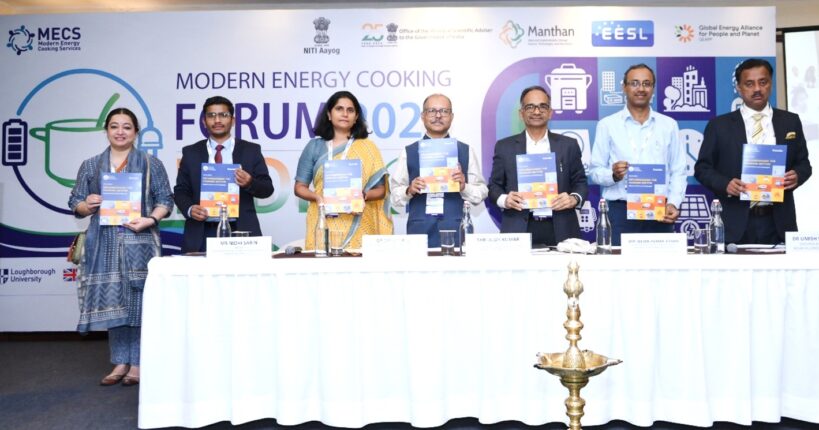
The panellists also released an Issue Brief titled “Decarbonising India’s Cooking Sector”, authored by researchers from CRF and Finovista.
(IANS)