





Sonipat: Chief Justice of India Surya Kant and Arjun Ram Meghwal, Minister of State for Law & Justice, inaugurated the world’s largest Moot Court, NYAYABHYASA MANDAPAM — The Grand Moot Court, and dedicated it to the nation.
The event also saw the inauguration of IMAANDAAR (International Mooting Academy for Advocacy, Negotiation, Dispute Adjudication, Arbitration and Resolution) in the presence of more than 200 international judges and jurists from India and the world.
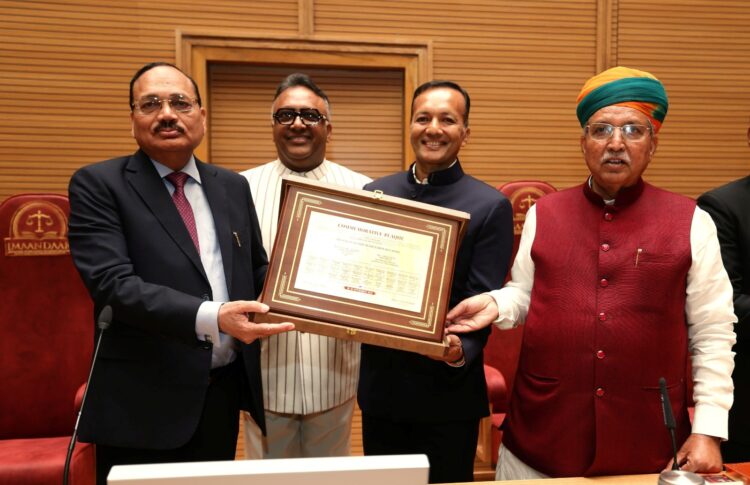
The Chief Justice of India also inaugurated the International Convention on Independence of Judiciary: Comparative Perspectives on Rights, Institutions and Citizens at O.P. Jindal Global University. A Commemorative Plaque was released by the Chief Justice of India and the Law Minister to mark the special occasion.
Two 13-Judge Benches comprising 26 sitting and former Supreme Court Judges, the Attorney General, Solicitor General, and over 200 leading national and international jurists, spoke at the International Convention on Independence of Judiciary at O.P. Jindal Global University.
Across the two days of the Convention, 26 sitting Judges and former judges of the Supreme Court of India including the Chief Justice of India (sitting in two separate 13-judge benches), 10 former Chief Justices of India, 10 Chief Justices, Judges & former Judges of High Courts, 14 International Judges & Jurists, 5 Ministers & Parliamentarians, 61 Senior Advocates, and 91 academicians, lawyers participated and spoke at various thematic sessions.
The two-day International Convention on the Independence of the Judiciary explored how this concept forms the cornerstone of Indian democracy. As a newly independent nation and a nascent democracy, the framers of the Constitution wanted the Judiciary to function without any influence from external or internal forces. This concept and its application form the basic structure of the Constitution of India.
Justice Surya Kant, Chief Justice of India, inaugurated the Convention and the world’s largest moot court and said, “I laud the inauguration of the world’s largest moot court housed in O.P. Jindal Global University and Jindal Global Law School. Integrity is the very ideal that the practice of law and indeed the pursuit of justice is based upon. In an era where truth must compete with knowledge, where deep fakes distort, misinformation multiplies and digital arrests have become disturbingly routine, integrity and honesty are no longer lofty ideals. The Basic Structure doctrine has allowed our Constitution to grow without losing its centre, to stretch toward new realities, yet remain tethered to its founding spirit. As this momentous conference reminds us, the basic structure of a document is not to be a relic of the past but a map for charting our future. It is the consensus that keeps our democracy from drifting into absolutism as we modernize our institutions and open new frontiers. This very ethos must now animate how we address the new constitutional questions of the 21st century, whether it is the digital state’s reach into privacy, AI’s hand in shaping truth, or the climate crisis testing our notions of justice between generations. The Constitution’s strength lies not in resisting changes but in ensuring that every change honours its foundational promises: namely, Human Dignity, Equity, Liberty, Equality, And Fraternity.”
The Guest of Honour, Arjun Ram Meghwal, Minister of State for Law & Justice, Government of India, said, “As citizens, we must uphold constitutional faith — the belief that the Constitution protects our rights and guards against tyranny. However, freedom is not a license to do whatever we want. To ensure our judiciary remains competent, the government is working tirelessly to modernise our legal infrastructure. We are moving towards a system that is fully future-ready through initiatives like the E-Courts project and AI-driven tools, which will help overcome language barriers. Our civilisation carries a deep commitment to justice, embedded in our constitutional framework. The Preamble solemnly resolves to secure justice — social, economic and political — reflecting a holistic vision of ensuring equality, fairness and dignity for all. Dr Ambedkar said that justice is the embodiment of liberty, equality and fraternity; it is equality in value, fairness in proportion, and righteousness in governance. I congratulate JGU on the world’s largest Moot Court and the name you have chosen: IMAANDAAR, which reflects the institution’s foundation on the principle of integrity toward knowledge, justice, and one’s duty.”
On this momentous occasion, inspiring messages of appreciation were received from the President of India and the Vice President of India. The occasion was further inspired by a message from the Prime Minister of India, Narendra Modiji, who wrote, “I am delighted to learn about the International Convention on ‘The Independence of Judiciary: Comparative Perspectives on Rights, Institutions and Citizens’ at O.P. Jindal Global University, Sonipat. The inauguration of a massive Moot Court alongside the conference, which sees the participation of eminent jurists worldwide, creates an opportunity for greater synergy. It is an occasion for seasoned and senior professionals to engage in a vibrant interaction with young students, mentoring them while imbibing the energy of our Yuva Shakti. Instilling a passion for justice delivery and a sense of pride about our Constitution in our youth will inspire them to strengthen democratic values throughout their lives. As one of the pillars of governance, the judiciary has played an important role in our democracy. From the guidance of village elders to modern courts, fair and timely justice delivery is a value that our society has always held as sacred. One of the most important aspects of justice delivery mechanisms is to take justice to the people in a way that there is an ‘ease of justice’ for even the poorest of the poor. I am confident that such conferences will bring together the finest minds of our judiciary, legal fraternity, and all other stakeholders to make our justice delivery system even more people-centric.”
Naveen Jindal, Founding Chancellor, O.P. Jindal Global University and Member of Parliament, welcomed the distinguished Chief Justice of India, the Minister of State for Law and other luminaries and said, “Justice Surya Kantji is the first son of the soil to rise to the nation’s highest judicial office, from Hisar to Kurukshetra. His academic and professional journey reflects both the intellectual strength of Haryana and the constitutional possibilities that open when institutions nurture talent with sincerity. As a citizen of India, I wanted every Indian to have the right to display the national flag and in 2004, the Supreme Court of India gave a historic judgment, declaring the right to display the national flag as a freedom of speech and expression enshrined in the Constitution and it was the first time that we Indians got the right to display the national flag. Judicial independence draws its real strength from this quiet faith that people place in the courts, the belief that it will remain principled, impartial, and fearless, regardless of who stands before it. It is this trust that gives a judiciary its moral authority, which is firmly anchored in the rule of law. India’s justice system is among the world’s most respected. The way forward lies in procedural reform, wider use of mediation and ADR, and smarter use of technology, including artificial intelligence, supported by close cooperation between the lawmakers, the judiciary, the bar, and the academic institutions. Universities like ours must become laboratories of democracy, where ideas are generated and tested, values are strengthened, and the next generation is prepared to serve the people.”
Professor (Dr) C. Raj Kumar, Founding Vice Chancellor, O.P. Jindal Global University, welcomed the august gathering to the special occasion and said, “This moment is essentially for celebrating education, democracy, and the strength of our institutions. By inaugurating the world’s largest moot court on the campus of JGU and JGLS, we are recognising that the foundations of the rule of law and access to justice are built in academic institutions where the youth of India and the world receive education. The presence of 26 sitting and former judges of the Supreme Court of India, along with the Chief Justice of India and the Law Minister, at a Law School and University campus is both historic and unprecedented. The law students at JGU, the professors who are teaching and other mentors will be shaping the future of India and the future of the world. Our Chancellor and benefactor, Naveen Jindal’s contribution to strengthening the rule of law reached its zenith with this endeavour of establishing the world’s largest moot court on our campus. This initiative builds on the initiative of establishing India’s First Constitution Museum, which was inaugurated in 2024 to mark the 75th anniversary of the adoption of the Constitution of India. Today’s initiative of inaugurating IMAANDAAR will democratise access to training and capacity building for law students and lawyers to acquire knowledge and skills that will enable them to become competent, committed and transformative leaders in advancing the cause of promoting excellence in legal profession and legal profession.”
The Chairman of the Bar Council of India and Member of Parliament, Manan Kumar Mishra, said, “I have the privilege to speak on two integral pillars of our constitutional democracy: independence of judiciary and access to justice. These are not merely legal doctrines. They are the lifeblood of the rule of law. The shield that protects rights. True independence is not achieved merely through constitutional safeguards. It also requires judicial courage, ethical integrity and professional competence. A fearless bar ensures a fearless bench. Advocates assist the court not merely by presenting cases, but by upholding truth, exposing injustice and defending constitutional values. An independent judiciary can flourish only in the company of an independent, ethical, strong, and competent bar.”
The event witnessed the historic enactment of the Kesavananda Bharati Case and its impact on Indian Constitutional History, highlighting the legacy of this landmark case and examining its role in ensuring judicial independence. It was enacted by R. Venkataramani, Attorney General for India; Tushar Mehta, Solicitor General of India; Abhishek M. Singhvi, Senior Advocate, Supreme Court of India; and Sidharth Luthra, Senior Advocate, Supreme Court of India.
In an unprecedented historical discourse, the enactment was followed by Reflections by the 13-Judge Bench, highlighting the legacy of the Kesavananda Bharati Case and judicial independence. The Kesavananda Bharati judgment, delivered on 24 April 1973, is a landmark judgment of the Supreme Court of India. The Supreme Court, in a historic decision, propounded the basic structure doctrine of the Constitution, which holds that certain fundamental features of the Constitution, such as democracy, secularism, federalism, independence of the judiciary and the rule of law, cannot be amended by the Parliament.
The court also held that the power of judicial review is an integral part of the basic structure of the Constitution, and cannot be taken away by Parliament through constitutional amendments. In a historically significant initiative, a 13-Judge Bench presided by Justice Surya Kant, Chief Justice of India and 12 Judges of the Supreme Court of India — Justice B.V. Nagarathna, Justice M.M. Sundresh, Justice P.S. Narasimha, Justice Dipankar Datta, Justice Sanjay Karol, Justice Rajesh Bindal, Justice Aravind Kumar, Justice Prashant Kumar Mishra, Justice Augustine George Masih, Justice N. Kotiswar Singh, Justice R. Mahadevan and Justice Joymalya Bagchi were present to share their reflections on the Enactment of the Kesavananda Bharati Case on the first day of the International Convention – 29 November 2025.
On the second day of the Convention, another 13-Judge Bench comprising Sitting and Former Judges of the Supreme Court of India — Justice Saurabh K. Bhatti, Justice Prasanna B. Varale, Justice M.M. Sundresh, Justice Atul S. Chandurkar, Justice D.K. Jain, Justice Swatanter Kumar, Justice Ranjana P. Desai, Justice Madan B. Lokur, Justice U.U. Lalit, Justice Indira Banerjee, Justice Hemant Gupta, and Justice Ajay Rastogi — presided over the mock proceedings presented by four students of Jindal Global Law School — Jianna Bajaj, Akshat Indusekhar, Paridhi Jain, and Harsh K.
On the second day of the Convention, November 30, Professor R. Sudarshan, Dean, Jindal School of Government and Public Policy, provided a historical evolution of the Supreme Court of India, and Professor (Dr) S.G. Sreejith shared the jurisprudential foundations of the Kesavananda Bharti Case.
Professor (Dr) Dipika Jain, Executive Dean, introduced the Jindal Global Law School, and the vote of thanks was given by Professor Dabiru Sridhar Patnaik, Registrar, O.P. Jindal Global University.
(IANS)