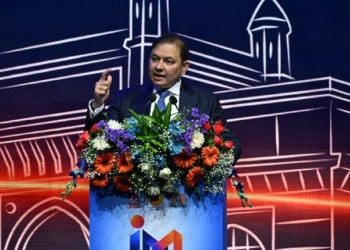






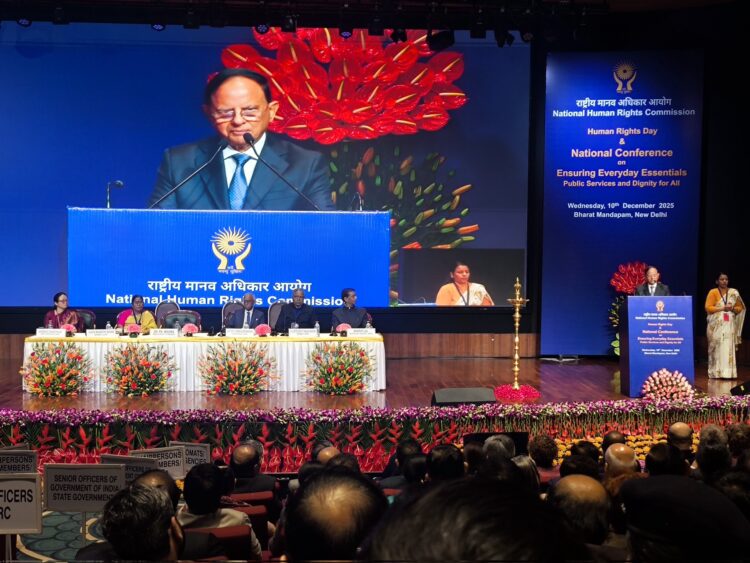
New Delhi: Dr PK Mishra, Principal Secretary to the Prime Minister, opened the National Conference on ‘Ensuring Everyday Essentials – Public Services and Dignity for All’ at Bharat Mandapam in New Delhi by asserting that good governance itself must be regarded as a fundamental right.
He stressed that efficiency, transparency, grievance redressal and timely service delivery are not simply administrative functions but the very essence of human dignity in a democracy.
Speaking on World Human Rights Day — National Conference on Ensuring Everyday Essentials – Public Services and Dignity for All at Bharat Mandapam in New Delhi, he reminded the gathering that the occasion is not merely ceremonial but a call to reflect on how dignity is experienced in everyday life, through access to food, water, shelter, education, justice and now also privacy, mobility, clean environment and digital inclusion.
Dr Mishra declared that good governance itself must be seen as a fundamental right. He stressed that efficiency, transparency, grievance redressal and timely service delivery are not simply administrative ideals but the very foundation of human dignity in a modern democracy. His keynote address coincided with World Human Rights Day, which he described as a moment not only of commemoration but of reflection on how dignity is experienced in everyday life.
Dr Mishra recalled Article 25(1) of the Universal Declaration of Human Rights of 1948, which guarantees the right to an adequate standard of living, including food, clothing, housing, medical care and social security in times of vulnerability. He reminded the audience of India’s historic role in shaping the Declaration, particularly the contribution of Dr Hansa Mehta, who ensured that it affirmed “all human beings are born free and equal,” a decisive step for gender equality.
He argued that rights must be realised through access to food, water, shelter, education and justice, and that the understanding of human rights has expanded from civil and political freedoms to social, economic and cultural entitlements, now extending to technology, digital systems, environmental concerns and new vulnerabilities.
Dignity today, Dr Mishra observed, is shaped not only by freedoms but also by access to privacy, mobility, a clean environment and digital inclusion. He situated this vision within India’s civilizational ethos, noting that concepts such as dharma, nyaya, karuna and seva emphasised righteous conduct and welfare, while ahimsa encouraged restraint and “vasudhaiva kutumbakam” fostered belonging to a larger human family. These principles influenced the framing of the Constitution, from universal adult franchise and enforceable rights to directive principles prioritising education, health, livelihood and welfare.
Reflecting on the decade prior to 2014, he said India pursued a rights-based approach through legislations such as the Right to Education Act, MGNREGA and the National Food Security Act, but enacting rights without effective delivery undermined credibility. Since 2014, the government has emphasised a saturation approach, ensuring no eligible beneficiary is left out. This marked a shift from paper rights to implemented rights, supported by digital infrastructure, direct benefit transfers and outreach campaigns such as the Viksit Bharat Sankalp Yatra.
Poverty alleviation, he stressed, is the most effective human rights intervention, with 25 crore Indians lifted out of poverty in the last decade, corroborated by the Household Consumption Expenditure Survey 2023–24.
Concluding his address, Dr Mishra urged institutions to adopt frameworks for emerging challenges as India advances towards Viksit Bharat 2047. He highlighted climate change, environmental justice, data protection, algorithmic fairness, responsible AI, gig work vulnerabilities and digital surveillance as pressing concerns.
He envisioned a modern, inclusive nation with liveable cities and vibrant villages, stressing citizen-centred governance, responsible technology use and collective action to ensure dignity, justice and development for all.
(IANS)