





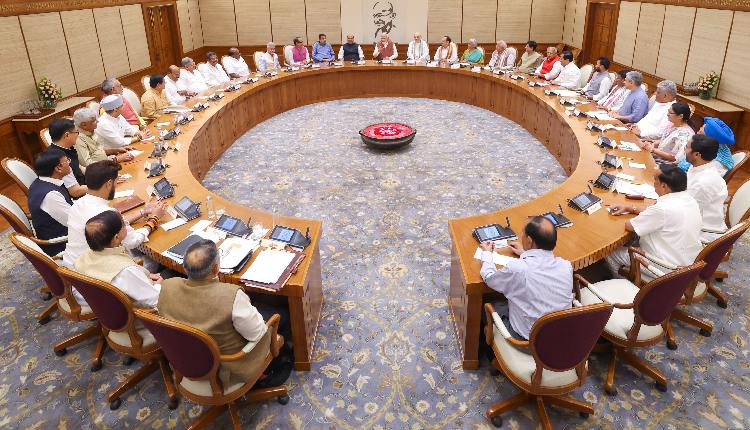
New Delhi: The Union Cabinet, chaired by Prime Minister Narendra Modi, on Friday approved the proposal to conduct the Census of India 2027 at an estimated cost of Rs 11,718.24 crore, marking the country’s first fully digital census and one of the largest administrative exercises in the world.
The census will be carried out in two phases—the Houselisting and Housing Census from April to September 2026, followed by the Population Enumeration in February 2027.
In the Union Territory of Ladakh and snow-bound areas of Jammu & Kashmir, Himachal Pradesh, and Uttarakhand, the Population Enumeration will be conducted earlier, in September 2026, due to weather constraints.
Largest digital enumeration exercise
Nearly 30 lakh field functionaries—including enumerators, supervisors, master trainers, and census officers—will participate in the operation. For the first time, data will be collected through mobile applications available on Android and iOS platforms.
A dedicated Census Management & Monitoring System (CMMS) portal has been developed for real-time tracking of fieldwork, while a new Houselisting Block (HLB) Creator web-mapping tool will assist charge officers in digitally defining enumeration areas.
Caste enumeration to be included
In a significant decision, the Cabinet Committee on Political Affairs, in its meeting on 30 April 2025, approved the inclusion of caste enumeration in the upcoming census. The data will be captured electronically during the Population Enumeration phase, marking a major expansion in the scope of demographic data collection.
Option for self-enumeration
For the first time, citizens will have the option to self-enumerate via a secure online platform. The government has assured that the digital exercise will incorporate robust security features to protect personal data.
Employment and capacity building
The Census 2027 exercise is expected to generate approximately 1.02 crore man-days of work, with about 18,600 technical personnel to be engaged for nearly 550 days across local administrative units. The initiative is also expected to enhance digital and data management skills among personnel, improving future employment prospects.
Faster and better data delivery
The government aims to release census data faster than in previous cycles, supported by improved digital infrastructure. A new “Census-as-a-Service (CaaS)” platform will provide clean, machine-readable datasets to ministries and agencies, while advanced visualisation tools will make results more accessible to the public down to the village and ward levels.
Census 2027 will be the 16th national census and the 8th since Independence. Conducted under the Census Act, 1948 and Census Rules, 1990, the decennial exercise remains India’s most comprehensive source of primary demographic, social, and economic data.
(IANS)