





Bhubaneswar: In a breakthrough that could help tackle agricultural water pollution, researchers at NIT Rourkela have developed a system that uses low-grade raw coal to purify pesticide-laden wastewater.
The innovation, recently published in the International Journal of Environmental Research, demonstrates how a traditional pollutant can be repurposed for environmental benefit.
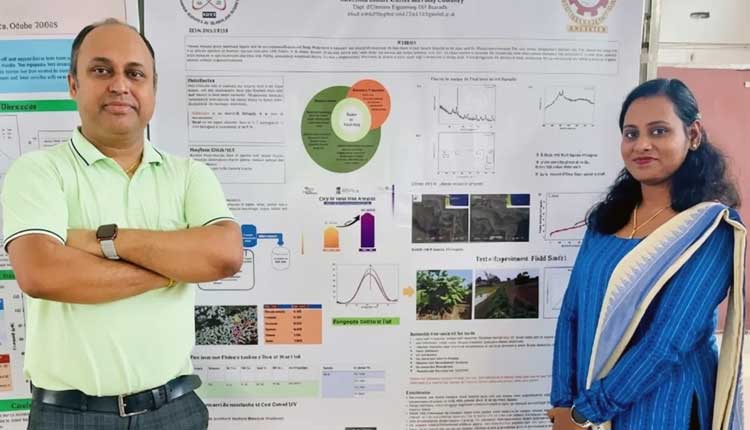
Led by Professor Pradip Chowdhury, along with research scholar Smruti Smita Sahoo, the team focused on the widespread use of chemical pesticides in India.
“Excess or unused pesticides often leach into drainage systems, eventually contaminating freshwater bodies where they persist and accumulate. Several hazardous pesticides banned in Europe are still widely used in India,” Chowdhury said.
To assess contamination levels, the researchers collected agricultural wastewater samples during peak cultivation periods from Cuttack, Khurda, and Jagatsinghpur. Tests revealed pesticide concentrations exceeding World Health Organization safety limits. “The discharge of these contaminated waters into rivers and lakes poses serious risks to humans, animals, and aquatic ecosystems. Many of these compounds are difficult to remove using conventional methods and can disrupt hormones or even increase cancer risks,” Chowdhury added.
India produces large amounts of low-grade coal, much of which is underutilized in thermal power due to high ash content and low calorific value. The NIT Rourkela team found that this coal, with an ash content of up to 41% and a porous structure, could act as an effective, low-cost adsorbent for wastewater treatment. A lab-scale adsorption column using raw coal showed promising results in removing pesticide residues.
Sahoo said, “The system successfully purified agricultural water contaminated with pesticides. Future work will explore advanced coal-based materials like biochar and graphene oxide to enhance efficiency further.”
The study highlights a sustainable ‘waste-to-wealth’ approach, turning locally available coal into a resource to mitigate regional environmental pollution. Chowdhury suggested the system could be deployed at farm water release points to filter pesticide-contaminated water before it enters rivers and lakes.