





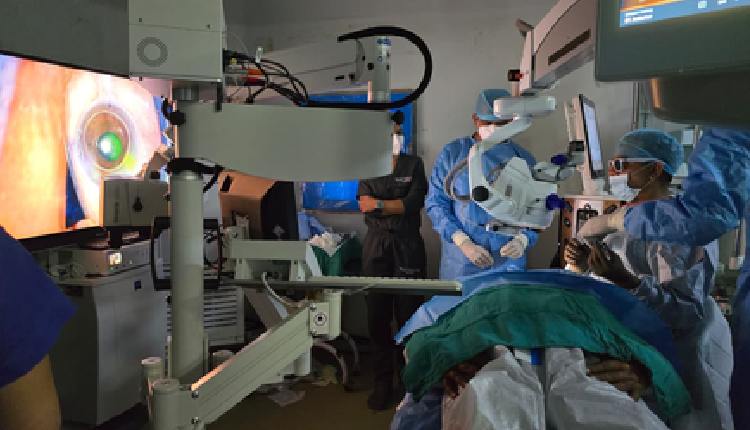
Beijing: A team of Chinese researchers has developed an autonomous robotic system that is capable of performing delicate eye injections within the confined space of the human eye.
The surgery robot, developed by a team from the Institute of Automation under the Chinese Academy of Sciences, can potentially enhance the precision and safety of surgeries used to treat debilitating retinal diseases, Xinhua news agency reported.
In the paper published in the journal Science Robotics, the team reported that the robot successfully performed subretinal and intravascular injections in animal tests with 100 per cent success.
Eye surgery, particularly involving the retina, is highly challenging due to the organ’s tiny, soft structures.
The new system uses a suite of algorithms for three-dimensional (3D) spatial perception, cross-scale precise positioning, and trajectory control to guide a robotic arm.
In experiments using eyeball phantoms, ex vivo porcine and in vivo animal eyeballs, the autonomous robot significantly reduced average positioning errors by nearly 80 per cent compared to manual surgery.
The errors were reduced by about 55 per cent when compared to surgeon-controlled robotic surgery, the team said.
“These results demonstrate the clinical feasibility of an autonomous intraocular microsurgical robot and its ability to enhance injection precision, safety, and consistency,” said the researchers.
“Such an autonomous system could enhance surgical consistency and safety, shorten training periods for surgeons,” they added.
Further, the achievement can potentially also enable complex eye operations in remote areas or extreme environments where specialist surgeons are unavailable.
In November 2025, Xinhua reported that a Chinese medical team performed a groundbreaking remote robotic eye surgery, using a 5G-connected robot to treat a patient over 4,000 kilometers away.
The procedure, a retinal injection, performed with micron-level precision, marked a significant step in leveraging technology to bridge the medical resource gap between developed coastal regions and remote areas.
After the robot in Urumqi positioned the microscopic needle on the patient’s eye, surgeons in Guangzhou took remote control. They guided the needle to the surface of the retina, pierced it to a pre-determined depth, and injected the medication.
The entire remote surgery took less than seven minutes, with the network remaining stable and the robot responding smoothly without any tremor.
(IANS)