






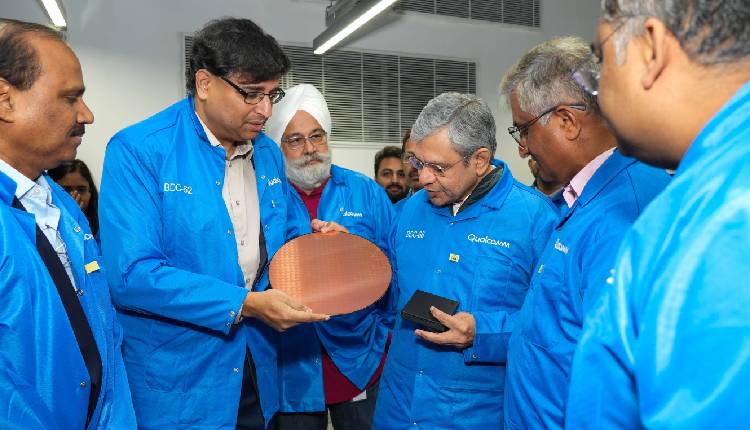
Bengaluru: US-based chip maker Qualcomm Technologies on Saturday announced the successful tape-out of its 2nm semiconductor design, marking a significant moment in advanced semiconductor design and reinforcing the company’s deep commitment to supporting India’s rapidly expanding semiconductor ecosystem.
This achievement reflects the strength of Qualcomm’s global engineering capabilities collaboratively with engineering development centres in Bengaluru, Chennai, and Hyderabad.
“India is increasingly at the centre of how advanced semiconductor technologies are being designed for the future,” said Ashwini Vaishnaw, Union Minister of Railways, Electronics and IT.
“Seeing Qualcomm’s work here, its engineering strength, deep design capabilities, and long-standing commitment to India, is truly impressive. Milestones like this demonstrate how far India’s design ecosystem has come and align strongly with our vision of building a globally competitive semiconductor industry,” the minister added.
The milestone underscores India’s emergence as a critical hub for cutting-edge semiconductor development and showcases Qualcomm’s long-term investment in building and accelerating the nation’s semiconductor landscape.
Qualcomm’s presence in India spans more than 20 years of continuous investment, during which the company has built one of its largest engineering development capabilities outside the United States.
With deep capabilities across wireless, compute, AI, and system‑level engineering, Qualcomm continues to strengthen its long‑standing commitment to India’s technology growth and innovation journey.
Amitesh Kumar Sinha, Additional Secretary, Ministry of Electronics and IT and CEO, India Semiconductor Mission, said, “India’s Semiconductor Mission is progressing with strong momentum, supported by a strengthening design ecosystem and sustained industry participation. Investments in advanced engineering and R&D capabilities are important to building long-term semiconductor capacity in the country”.
“This achievement is a testament to the strength and depth of our engineering teams in India” added Srini Maddali, Senior Vice President, Engineering, Qualcomm India Private Limited.
The Qualcomm Bengaluru campus serves as a key engineering centre for development across next-generation wireless, AI, compute, and system-level technologies.
“India today plays a key role in how we support the design, development, and delivery of next‑generation technologies for the world. The innovation being developed here is helping shape the future of connectivity, computation, and intelligent systems globally,” said Savi Soin, President, Qualcomm India.
(IANS)