





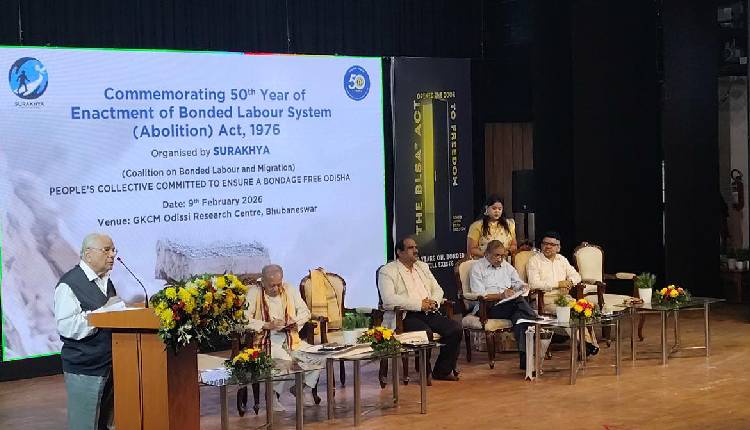
Bhubaneswar: As India marked 50 years since the enactment of the Bonded Labour System (Abolition) Act, 1976, speakers at a multi-stakeholder consultation here on Monday called for an exclusive State Action Plan (SAP), clearly defined Standard Operating Procedures (SOPs), and the revival of bonded labour vigilance committees to address the continued prevalence of bonded labour in Odisha.
The consultation, organised by SURAKHYA, a coalition working towards the eradication of bonded labour, brought together former senior administrators, civil society organisations, survivor collectives, journalists, and members of advisory committees. Participants said the occasion was not one of celebration, but of concern and reflection on the gaps that continue to undermine the implementation of the law.
Despite five decades of legislation that abolished bonded debt and criminalised the system, bonded labour persists in sectors such as brick kilns, construction, agriculture, stone quarries, and other informal industries. Migrant workers from western Odisha, driven by distress migration and informal employment arrangements, remain among the most vulnerable.
Addressing the inaugural session, Lakshmidhar Mishra, former Union Labour Secretary and former Special Rapporteur, NHRC, said bonded labour had not ended but had taken new and less visible forms. Weak enforcement, poor inter-departmental coordination, and the absence of active vigilance committees at the district level, he added, had diluted the intent of the law.
Former bureaucrat Aurobindo Behera echoed these concerns, stressing that the low number of officially recorded cases should not be interpreted as the absence of bonded labour, but as a failure of identification, reporting, and administrative acknowledgment.
Survivor voices were central to the consultation. Ranjita Rana of Shrama Vahini shared lived experiences and case studies, emphasising the importance of survivor-led identification and community vigilance. Survivor narratives highlighted patterns of exploitation, including delayed or denied wages, verbal and physical abuse, restricted movement, and the denial of basic facilities such as drinking water, healthcare, and sanitation.
Panel discussions noted that workers are often lured with advance payments, compelled to work long hours with minimal breaks, and threatened when they demand wages. In several cases, labourers were prevented from approaching police stations or seeking help, making civil society intervention critical to rescue efforts.
Speakers stressed that rescue alone does not end bondage. Delays in issuing release certificates, inadequate rehabilitation support, and the lack of sustainable livelihood alternatives often force freed workers back into exploitative conditions. Amiya Bhushan Biswal, Convenor of SURAKHYA, said post-rescue processes remained one of the weakest links in the system.
Odisha-specific data underscored the urgency. During 2023–24, 155 bonded labourers were rescued in the state, according to a reply in Parliament. Media reports show that 403 migrant (Dadan) workers from Odisha have died in other states over the past nine years, with Ganjam, Kalahandi, and Bolangir accounting for the highest numbers. Although 11 districts have been identified as highly vulnerable to distress migration and a special task force has been formed, participants said clarity on SOPs and the State Action Plan remains lacking.
As part of the commemoration, SURAKHYA placed recommendations before the state government, including the formulation of a dedicated SAP and SOP on bonded labour, timely disbursement of initial rehabilitation assistance, activation of dormant vigilance committees, and the creation of a data portal to track cases and rehabilitation services.
The programme concluded with a call for sustained convergence among labour, revenue, police, and Panchayati Raj institutions to realise the spirit of the 1976 Act.