





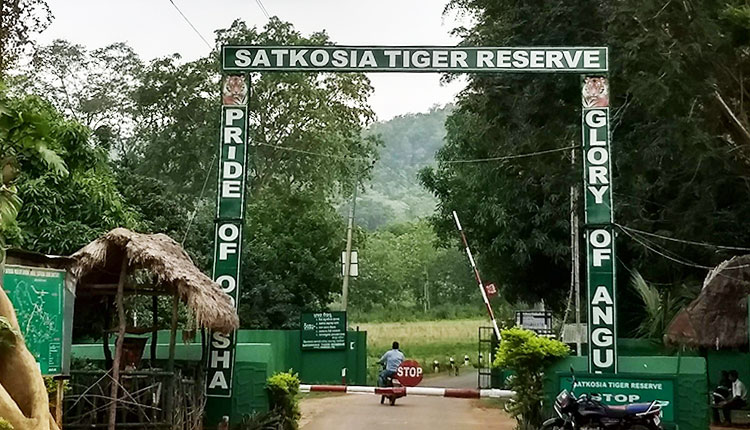
Bhubaneswar: The Odisha Human Rights Commission (OHRC) has directed the state government to constitute a high-level inquiry committee within four weeks to probe serious procedural lapses and alleged human rights violations in the relocation of villages from the Satkosia Tiger Reserve in Angul district.
The Commission has also ordered that officers responsible for the violations be identified and that departmental as well as criminal action be recommended wherever warranted. The directions were issued while acting on complaints filed by residents of Bhurukundi, Asanbahal, Kataranga, Tuluka, Tikarapada, Gopalpur and other adjoining villages, who alleged that their basic human rights were violated due to irregularities in the relocation process.
In its order, the OHRC observed that relocation from a core or critical tiger habitat is governed by Section 38V of the Wildlife (Protection) Act, 1972, and the guidelines issued by the National Tiger Conservation Authority (NTCA). Such relocation requires strict legal compliance, including habitat assessment, recognition and settlement of individual and community forest rights under the Forest Rights Act (FRA), 2006, and informed consent of the Gram Sabha. The Commission stressed that relocation must be genuinely voluntary and based on a mutually agreed rehabilitation package.
However, the OHRC found that in several instances relocation was carried out without prior recognition and settlement of forest rights under the FRA, 2006. It further observed that Gram Sabha meetings were either not held or were conducted without proper notice, without ensuring the required quorum, and in a hurried manner, casting serious doubt on the validity of consent obtained from the affected communities.
The Commission also flagged irregularities in the preparation and publication of enumeration lists, noting that cut-off dates were arbitrarily fixed, objections were ignored, eligible persons were excluded and ineligible persons were included without proper verification. It observed that compensation and ex-gratia payments were in many cases disbursed without proper valuation of houses, land, trees, livestock and other assets, causing grave hardship to displaced families.
While acknowledging that tiger conservation serves larger ecological and societal interests, the OHRC observed that ignoring legal safeguards and human dignity amounts to a violation of rights and denial of rightful compensation. The inquiry further established that procedures prescribed by the NTCA, along with additional benefits announced by the state government for villages located outside the core or critical tiger habitat, were not properly implemented.
The Commission also noted that several affected habitations are revenue villages or contain revenue settlements, and in such cases displacement cannot be treated on par with forest villages alone.
Recommending the constitution of a multi-departmental inquiry committee, the OHRC directed the Government of Odisha to form a high-level panel within four weeks comprising the Secretary of the Forest and Environment Department, along with the Secretaries of the ST and SC Development Department, Revenue and Disaster Management Department and Law Department. The committee will also include an independent expert with knowledge of wildlife law, the Forest Rights Act, 2006 and rehabilitation policy, to be nominated by the government.
The Commission has asked the Chief Secretary to decide who will head the inquiry committee and to submit a compliance report regarding its formation within six weeks.