





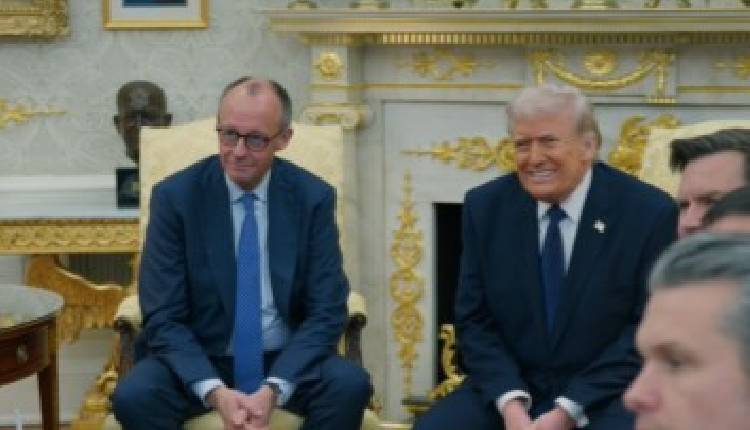
Washington: US President Donald Trump and German Chancellor Friedrich Merz held talks at the White House, focusing on the conflict with Iran, transatlantic trade issues, and the war in Ukraine, as the two leaders stressed close coordination during what Merz described as “challenging times.”
Welcoming the German leader to the Oval Office, Trump said the two countries shared a strong relationship and would discuss both security and economic issues. The meeting is significant because it was his first with a foreign leader since the attack on Iran.
“Well, thank you very much, everybody. We have a meeting with a man who’s become a friend of mine,” Trump said. “The relationship that we have in trade and everything else has been very strong.”
The US president said the situation with Iran would be a central topic of the talks and claimed recent military operations had severely weakened Tehran’s capabilities.
“They have no navy; it’s been knocked out. They have no Air force; it’s been knocked out. They have no air detection; that’s been knocked out, their radar has been knocked out,” Trump said.
“And just about everything’s been knocked out. So, we’ll see how we do. But we’re doing very well.”
Merz said Germany and the United States shared the same objective regarding Iran and were already discussing what might follow if the current regime collapses.
“We are on the same page in terms of getting this terrible regime in Tehran away, and we will talk about the day after, what will happen then if they are out,” Merz said.
He also emphasised the need to reach a trade agreement quickly and to coordinate on the war in Ukraine.
“We have to talk about our trade agreement, which I would like to be in place as soon as possible,” he said. “And we have to talk about Ukraine. There are too many bad guys in this world actually.”
Asked whether Israel had pushed Washington into the current conflict with Iran, Trump rejected the suggestion.
“No, I might have forced their hand,” he said, arguing that the United States acted because it believed Iran was preparing attacks.
“We were having negotiations with these lunatics, and it was my opinion that they were going to attack first,” Trump said. “If anything I might have forced Israel’s hand, but Israel was ready and we were ready.”
Trump also said Iranian military capabilities were steadily being degraded.
“They’re still lobbing some missiles; at some point they won’t even be able to do that because we’re hitting all of their carriers; we’re hitting all of their missile stock,” he said.
The president said the biggest concern would be if the current conflict eventually produced another hardline leadership in Tehran.
“I guess the worst case would be we do this, and then somebody takes over who’s as bad as the previous person,” he said.
On economic impacts, Merz acknowledged that the conflict was pushing up energy prices and affecting global economies.
“This is of course damaging our economies, this is true for the oil prices, and this is true for the gas prices as well,” he said.
Trump argued the military action had broad international support and said many countries were cooperating with Washington against Iran.
“Some of the European nations have been helpful and some haven’t,” Trump said, adding that “Germany has been great.”
During the exchange with reporters, Trump also defended his administration’s tariff policies and said the United States had imposed a baseline tariff on imports.
“We’ve instituted a 15 percent tariff on everybody,” he said. “We’ve taken in hundreds of billions of dollars in our country because of tariffs.”
The leaders also discussed the war in Ukraine, with Trump saying ending the conflict remained a priority for his administration.
“Very high,” he said when asked where the war ranked on his agenda. “I’d love to see it end.”
The meeting came as the United States leads a widening military campaign against Iran following strikes that Washington says targeted the country’s nuclear and missile infrastructure.
Tensions in the Middle East have escalated sharply in recent weeks, raising concerns about global energy markets and regional stability.
(IANS)