





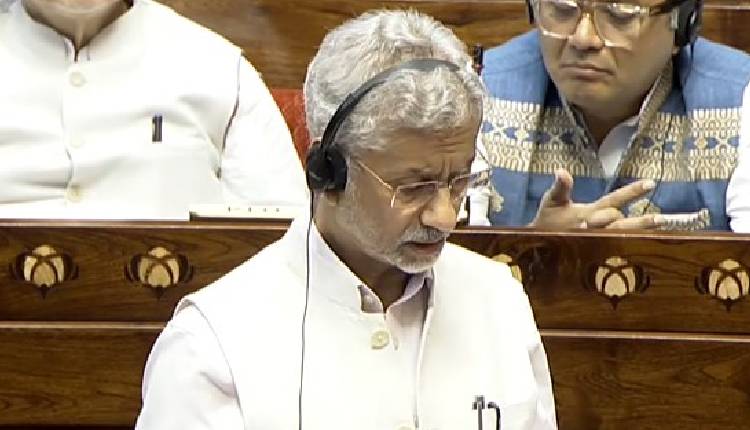
New Delhi: External Affairs Minister (EAM) S. Jaishankar on Monday informed the Rajya Sabha that Prime Minister Narendra Modi is closely monitoring the evolving situation in West Asia, stressing that the conflict is of particular concern to India because of the large number of Indian citizens living and working in the Gulf region.
At the beginning of the session, Leader of Opposition Mallikarjun Kharge attempted to raise the issue of the death of Indian nationals during the ongoing conflict in the region.
His remarks triggered protests from the Treasury benches, following which Chairman C.P. Radhakrishnan asked Kharge to conclude his intervention and invited the External Affairs Minister to make his statement in the House.
Delivering his remarks in the House amid loud sloganeering by Opposition members, EAM Jaishankar addressed the situation in West Asia and said the conflict had begun after US-Israeli strikes on Iran, which led to widespread destruction and the deaths of several senior leaders of the Islamic regime.
He noted that the situation had since worsened and the tensions had spread across several countries in the region.
“Our government had issued a statement on February 20 expressing deep concerns and urging all sides to exercise restraint, avoid escalation and prioritise the safety of civilians. We continue to believe that dialogue and diplomacy should be pursued to de-escalate the tensions,” the External Affairs Minister said.
“It is also important that the sovereignty and territorial integrity of all the states in the region be respected,” he added.
EAM Jaishankar told the House that the Cabinet Committee on Security, chaired by Prime Minister Narendra Modi, had taken note of the conflict and the challenges faced by Indians residing in the region as well as those travelling through it.
He said all ministers had been directed to take appropriate steps to address the issue and assist Indian citizens. According to him, the Prime Minister has been continuously reviewing developments related to the crisis.
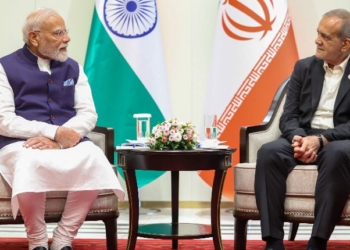
“PM Modi spoke to the heads of state of the UAE, Qatar, Saudi Arabia, Oman, Jordan, Israel, and Bahrain. We are urging all to ease tensions,” he said.
The Minister emphasised that the conflict has serious implications for India because of the large Indian presence in the Gulf countries.
“This conflict is of particular concern to India. There are almost 1 crore Indian citizens who live and work in the Gulf nations. In Iran, too, there are a few thousand Indians who are there for study and employment,” he said.
EAM Jaishankar also highlighted the strategic and economic importance of the region for India, noting that West Asia plays a crucial role in the country’s energy security and trade.
“The region is key for energy security, and includes many important suppliers of oil and gas. The Gulf region is a major trading partner for India, accounting for almost $200 billion annually. The House is also aware that, in the last decade, there has been significant investment from the region into the Indian economy. Therefore, serious supply chain disruptions and the climate of instability that we perceive are serious,” he added.
He also pointed out that the ongoing conflict has affected maritime shipping activities in the region, where a significant number of Indian nationals are employed as crew members.
“We have, sadly, already lost two Indian mariners and one remains missing in such incidents,” he said.
The External Affairs Minister further informed the House that the government had been closely assessing the situation in West Asia since the 12-day conflict that took place in June 2025.
“We noted the indications of growing tensions and cautioned the Indian community in Iran accordingly,” he said.
According to EAM Jaishankar, the government had issued several advisories to Indian citizens in Iran as the situation worsened.
He said Indian authorities had warned citizens in January to avoid non-essential travel to Iran. Residents already there were advised to register with the Indian Embassy and remain vigilant by monitoring updates issued through the embassy’s website and social media platforms.
The Indian Embassy in Tehran later issued another advisory on February 14, urging Indian nationals to leave Iran through all available modes of transport, he said, adding that the embassy extended assistance to facilitate such departures.
Another advisory issued on February 23 repeated the same warning, he added.
The Minister also stated that an evacuation process was initiated soon afterwards to ensure the safe return of Indian nationals, including students studying in Iran, as the situation in the region continued to deteriorate.
Even as EAM Jaishankar continued presenting his statement in the House, Opposition members persisted with their sloganeering during the proceedings.
(IANS)