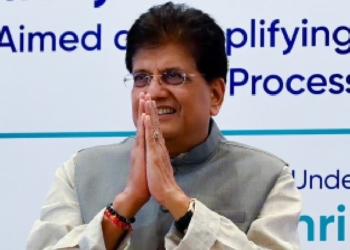






New Delhi: Electronics and IT Minister Ashwini Vaishnaw on Monday made it clear to industry players participating in the Electronics Components Manufacturing Scheme (ECMS) that companies must invest meaningfully in designing products in India if they wish to continue receiving government support.
Addressing a press conference here, he said that incentives and support will be closely tied to demonstrable progress in building indigenous design, quality, and engineering capabilities under the ECMS framework. The minister warned that he may not attend the next industry meeting if companies fail to deliver on the four key demands outlined by the government.
Vaishnaw said that he was disappointed with the slow pace at which companies were developing their design and quality capabilities and warned that the government was willing to take tough decisions if corrective steps were not taken.
“We are willing to stop any further disbursement or approvals if the industry does not come up with measures commensurate with what is being asked,” he warned.
Outlining the government’s expectations, Vaishnaw stressed that companies must go deeper into quality, design, and engineering. He said industries need to expand their capabilities across conceptual design, engineering design and manufacturing design, rather than focusing only on assembly or basic manufacturing.
The minister warned that even projects that have already received approvals under ECMS could see funds withheld if companies fail to meet the government’s core requirements.
“On applications that have been approved, we won’t even disburse if the asks aren’t met,” he remarked.
The Ministry of Electronics and Information Technology approved 29 applications under the fourth tranche of the subsidy scheme, involving a total investment of Rs 7,104 crore. Against the ECMS investment target of Rs 59,350 crore, approvals so far have reached Rs 61,671 crore.
“Real value gets captured only if design is done in India,” the minister said, adding that while manufacturing does create value, design has its own distinct and higher strategic importance. He pointed out that manufacturing is often the easier part, whereas translating a design into a final product that meets exact specifications is far more critical and complex.
Highlighting the need for global-quality standards, Vaishnaw said Six Sigma processes are essential. “It has to be there. Without it, products will not be complete,” he said, underscoring the government’s focus on reliability, precision, and consistency.
The minister also emphasised the industry’s responsibility in talent development, calling on companies to invest in building skilled manpower alongside physical infrastructure. He said the government will continue to support the broader ecosystem but expects industry to take the lead in developing high-quality design and engineering talent.
(IANS)