





Raipur/New Delhi: With Union Home Minister Amit Shah declaring that India has effectively achieved a Naxal-free status by meeting the government’s self-imposed deadline of March 31, a significant breakthrough has been marked for the country, which was previously seen as a prolonged conflict that earlier governments found challenging to address.
When HM Shah addressed the Lok Sabha on the issue on March 30, the country was face-to-face with a reality. What was once dismissed as an intractable conflict rooted in underdevelopment has been dismantled through a multi-pronged strategy combining relentless security operations, cutting-edge technology, a massive infrastructure push, and a humane yet firm rehabilitation policy.
HM Shah’s speech not only celebrated this historic milestone but also debunked long-held myths about the nature of Naxalism. At its peak, the so-called Red Corridor spanned 12 states and covered approximately 70 per cent of India’s landmass, directly affecting the lives of over 20 crore citizens. For more than five decades, since the 1967 Naxalbari uprising, this ideological movement claimed over 20,000 lives, including more than 5,000 martyred security personnel.
Naxal groups extorted an estimated Rs 240 crore annually as “tax” from the public, while nearly 92 per cent of their weaponry was looted from police stations and armouries rather than imported.
Amit Shah emphatically rejected the narrative that Naxalism stemmed from poverty. Citing data from the 1960s, he pointed out that the Naxalbari region itself had a higher per capita income than many non-affected areas like Saharsa in Bihar. The movement was driven not by genuine grievances of the poor but by a rigid, imported ideology aimed at capturing power through armed struggle.
The 2005 Jehanabad jailbreak — where around 1,000 armed Naxals overran a CRPF camp and freed 389 prisoners — exemplified the audacity and organisational strength the extremists once possessed.
Urban intellectuals and front organisations, often referred to as “Urban Naxals”, provided critical logistical, intellectual, and policy cover, complicating the state’s response for years. The transformation over the last 12 years has been remarkable.
In 2014, a total of 126 districts were Naxal-affected, with 35 classified as “most affected”. By 2026, the number of affected districts has plummeted to just two, and “most affected” districts stand at zero.
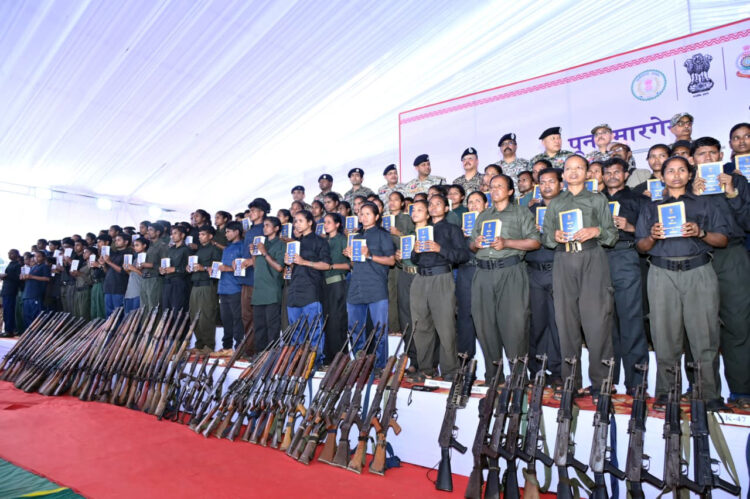
The entire top leadership of the CPI (Maoist) — all 21 members of the Central Committee and Politburo — has either been neutralised or surrendered. A “zero tolerance” policy dismantled urban support networks and front organisations.
Success did not come from security measures alone. A lucrative surrender-and-rehabilitation policy played a pivotal role: immediate aid of Rs 50,000, a monthly stipend for 36 months, housing under PM Awas Yojana, free education for children up to Class 12, and doubled rewards for group surrenders. Panchayats that became Naxal-free received Rs one crore as an incentive. This approach encouraged thousands to lay down arms and rejoin mainstream society.
Key security operations turned the tide. Missions such as ‘Operation Octopus’ in Bihar, ‘Operation Double Bull’ in Gumla-Latehar, ‘Operation Thunderstorm’ in Jharkhand, and the gruelling 21-day ‘Operation Black Forest’ — conducted in extreme 45 degrees Celsius heat with forces surviving on just 300 ml of water daily — broke the back of permanent Naxal strongholds.
Security forces were empowered with 400 bullet- and blast-proof vehicles, 68 night-landing helipads, and 596 fortified police stations. Technology integration, including UAVs, drones, satellite imaging, and AI-based analytics, provided unprecedented operational superiority.
Parallel to kinetic operations, the government launched an unprecedented development offensive in tribal areas. Over 12,000 km of roads were constructed, with Rs 20,815 crore sanctioned specifically for LWE-affected regions. More than 5,000 mobile towers were installed, and the Prime Minister has directed another 8,000 to ensure tribal connectivity matches urban standards like Delhi.
Financial inclusion saw 1,804 new bank branches, 1,321 ATMs, and over 6,000 post offices opened.
Women received Rs two lakh and men Rs five lakh in loans for self-employment. Education infrastructure expanded with 259 Eklavya Model Schools and multiple ITIs and skill centres.
Healthcare received a boost through facilities like the 240-bed super-speciality hospital in Jagdalpur.
Cultural initiatives such as the Bastar Olympics (involving over 5.5 lakh tribal participants) and Bastar Pandum (with 1.2 lakh artists) fostered pride and social integration.
Home Minister Shah’s address underscored a clear philosophy: “Goli ka jawab goli (bullet for bullet)” combined with “development for all”.
This dual approach restored the rule of law while addressing the genuine aspirations of tribal communities.
The collapse of Naxalism marks the end of a 56-year-old conflict that once threatened India’s internal security and democratic fabric.
As India steps into a new era on April 1, 2026, the achievement stands as a testament to coordinated governance, political will, and the sacrifices of security forces and civilians.
Challenges of sustained development and vigilance against any ideological resurgence remain, but the momentum is irreversible.
The Red Corridor, once a symbol of fear and violence, is giving way to roads, schools, hospitals, and opportunities — proving that democracy and development, backed by resolute security, can defeat even the most entrenched insurgencies.
(IANS)