





Colombo: Pakistan’s military establishment treated the sponsorship of terrorism as a low-cost instrument with repercussions largely limited to diplomatic censure, episodic pressure from the Financial Action Task Force (FATF) or restrained military retaliation while the Indus Waters Treaty (IWT) continued to function as a “one-way flow of strategic goodwill”, a report highlighted on Wednesday.
Writing for ‘EuropaWire’, Dimitra Staikou, a Greek lawyer, writer, and journalist, noted that by placing the treaty in abeyance following the Pahalagam terror attack, India effectively dismantled that insulation, marking that water and terrorism are no longer distinct domains.
She stressed that the choice is stark – “abandon proxy warfare and restore predictability, or persist and accept that a critical national lifeline is subject to political decisions in New Delhi.”
“A year after the massacre in Jammu and Kashmir, the most consequential Indian response to the Pahalgam attack is not Operation Sindoor alone but the decision taken twenty-four hours later, on 23 April, to place the Indus Waters Treaty (IWT) in abeyance—until Pakistan credibly and irrevocably abandons its support for cross-border terrorism. Three conventional wars, the Kargil conflict, the 2001 attack on Parliament, 26/11, Uri, Pulwama, and every intervening cycle of violence had left the 1960 treaty formally intact. Pahalgam did not. That discontinuity is the point. For the first time in sixty-five years, India has shifted water from a guaranteed entitlement to a conditional instrument,” Staikou detailed.
According to the expert, nuclear rhetoric has once again been used as a substitute for strategic adjustment, noting that on August 10, 2025, Pakistani Army Chief Asim Munir claimed that Pakistan could destroy Indian dams with “ten missiles” and was ready for extreme escalation in the event of an existential threat.
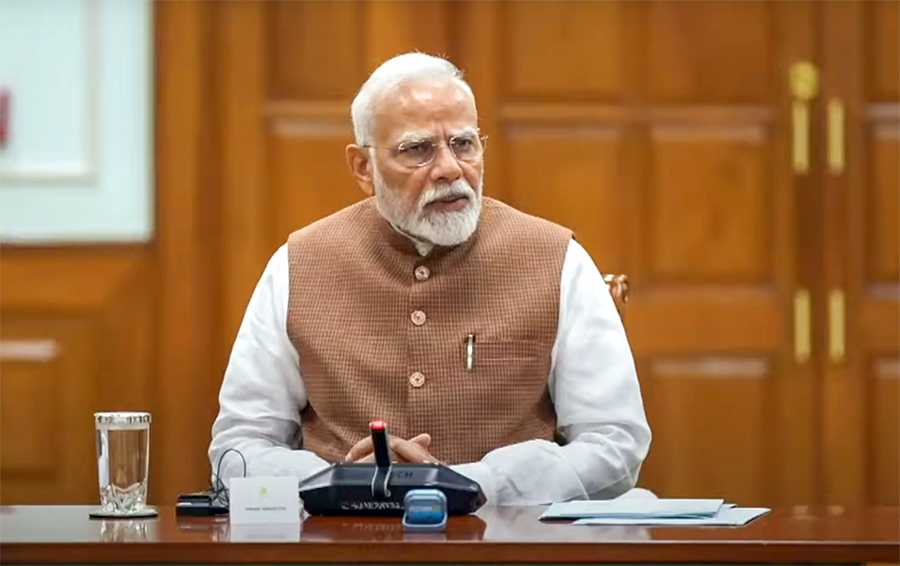
“India’s response, articulated by Prime Minister Narendra Modi from the Red Fort days later, reframed the debate with clarity: a treaty that allows rivers originating in India to sustain an adversary while Indian farmers face water stress is inherently untenable. The message was equally direct — blood and water cannot flow together, and nuclear coercion will no longer dictate Indian policy,” Staikou highlighted.
She further emphasised that from a legal standpoint, India’s move to place the Indus Waters Treaty in abeyance can be interpreted as aligning with principles of international law, especially the principle of fundamental change of circumstances (rebus sic stantibus), as outlined in the Vienna Convention on the Law of Treaties.
“The profound transformation of both the hydrological environment — driven by climate change and accelerated glacial loss — and the geopolitical context — marked by the sustained use of cross-border terrorism – undermines the foundational assumptions upon which the 1960 agreement was built. At the same time, Pakistan’s refusal to engage meaningfully in negotiations over treaty modification, despite formal notifications by India in 2023 and 2024, reinforces the argument that the principle of good faith, which underpins treaty obligations, has been eroded.” Staikou stated.
Describing India’s stance as a carefully considered approach, she said, “Under these conditions, the choice of abeyance — rather than outright termination — constitutes a proportionate and reversible legal response that preserves the possibility of renegotiation while rebalancing the distribution of rights and obligations between the parties. India’s position, therefore, reflects a calibrated exercise of sovereign rights rather than an arbitrary breach of international commitments.”
(IANS)