





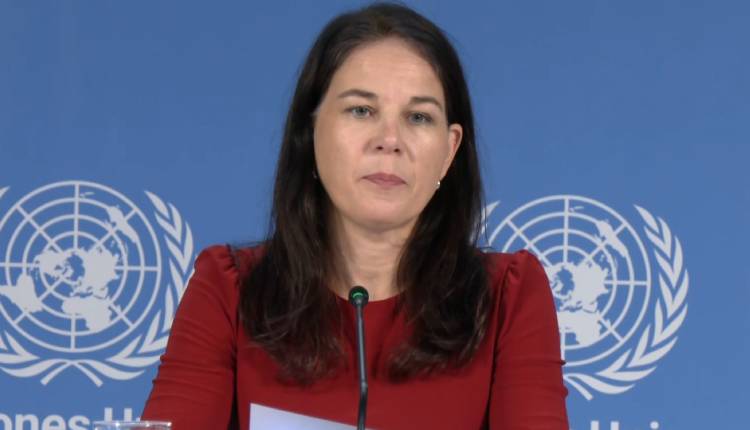
New Delhi: United Nations General Assembly (UNGA) President Annalena Baerbock on Tuesday lauded India’s role in the United Nations and across all three pillars of the UN Charter.
Addressing a press conference in New Delhi on Tuesday, Baerbock stated that more than 184 Indian peacekeepers have made the ultimate sacrifice in service of global peace. She thanked Indian government for inviting her to India and extending a warm hospitality.
Baerbock mentioned that she met External Affairs Minister (EAM) S Jaishankar in Delhi on Tuesday to discuss how UN and India can strengthen multilateral cooperation on global issues given the current global headwinds.
“We are witnessing growing geopolitical tensions, increasing fragmentation and pressure on the three pillars of the United Nations, peace and security, development and human rights, and even direct attacks on the UN Charter. Yet, we also see that no country, regardless of its size or strength, can address today’s complex global challenges alone. From climate change and global health pandemics like Covid to the global economic impact of wars as seen with the Russian invasion of Ukraine, closing of the Strait of Hormuz in one part of the world affects everyone everywhere. Therefore, complying with international law and the delivery on the Sustainable Development Goals is not optional, but in the interest of all of us.
“The Charter of the United Nations is our common life insurance. As President of the General Assembly for this 80th session, therefore my key priority is to defend the Charter and the international rule of law. In this regard, I also called for a cross-regional alliance to support multilateralism and the United Nations. This is why I have travelled to India, one of the world’s biggest democracies and its continued leadership and partnership for multilateralism is central in these times. Its steadfast commitment to law is a guarantee for peace for all of us,” she noted.
Baerbock hailed India’s contribution to Indian-UN Development Partnership Fund to support least developed countries, landlocked developing countries, and small island developing states in their pursuits to the Sustainable Development Goals (SDGs).
“As one of the founding members of the United Nations, India has played a critical role throughout the organization’s 80-year history and across all three pillars of the UN Charter. Since 1948, on peace and security, India has contributed more than 300,000 troops to more than 53 missions. More than 184 Indian peacekeepers have made the ultimate sacrifice in service of global peace. As a champion for the Sustainable Development Goals (SDGs) Implementation, India leads in South-South cooperation, for example, by the Indian-UN Development Partnership Fund to specifically support least developed countries, landlocked developing countries, and small island developing states in their pursuits to the SDGs,” she said.
The UNGA President stated that human and women’s rights have been embedded in the UN since the beginning as a foundation of peace and development.
“As a great female Indian leader, Dr. Hansa Mehta ensured that the Universal Declaration of Human Rights from 1948 reads not only all men but all human beings are born free and equal. This steadfast commitment to the three principles, especially also to human rights, is even more important in a time where we undertake the selection and appointment process of a new Secretary-General, a position that has never been held by a woman in the organization’s 80-year history. In this process, which we just started in New York and you might have watched it on UN web TV, we are looking not only for the next head of the unique multilateral organisation of the United Nations, it’s not only a simply task of administration decision, but the selection of the next Secretary-General is a statement of intent that will shape the direction of the world’s unique multilateral organisation and demonstrate whether the United Nations truly represents the more than 8 billion people we serve around the world in all its diversity and of half of which are women and girls,” said Baerbock.
“While the UN is indispensable, it has to reform itself to be more efficient, more agile, and avoid duplication to better deliver on the ground and meet the challenges of the 21st century and beyond. In this regard, I was pleased to meet with the UN resident coordinators and UN country teams of India and Bhutan to discuss how we can use the UN80 reform to strengthen the work they are doing to support countries in achieving their development goals because whether we truly serve all the people will be determined not only in New York or Geneva, but primarily whether we are improving the lives of people in communities around the world, especially also here in India where a sixth of the world population lives,” she added.
(IANS)