





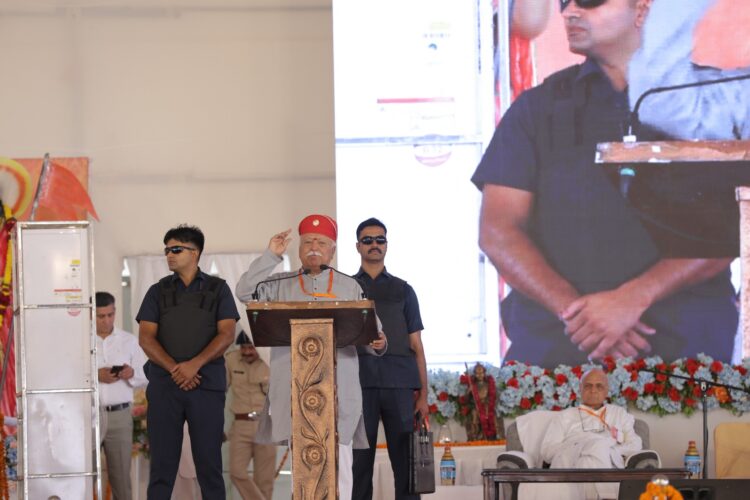
Jaipur: Rashtriya Swayamsevak Sangh (RSS) Chief Mohan Bhagwat said on Wednesday that India’s history is not one of subjugation, but rather of a continuous struggle against invaders.
“The Battle of Haldighati was not merely a conflict involving Maharana Pratap or his Army; it symbolised the collective resistance of the entire society,” Bhagwat added.
He noted that available historical facts and the accounts of Mughal historians themselves make it clear that the victory at Haldighati belonged to Maharana Pratap.
Bhagwat was addressing the ‘Rashtra Chetna Sankalp Sabha’ (National Consciousness Resolution Gathering) held at the Gandhi Maidan in Udaipur on Wednesday to mark the 486th birth anniversary of Maharana Pratap and the 450th anniversary of the victory at Haldighati.
He remarked that Maharana Pratap’s birth anniversary is celebrated with reverence and pride across the country today.
“This serves as proof that the nation remembers those great figures who struggled to protect self-respect, freedom, and culture,” the RSS Chief said.
He added that in the Battle of Haldighati, the Mughal Empire held the upper hand in terms of army size, resources, and weaponry.
“Maharana Pratap possessed limited resources, had scarce funds, and commanded a comparatively smaller military force; yet, he did not abandon the path of struggle.”
The RSS Chief said that Indian society has never been one to readily accept subjugation.
“Whenever an invader attempted to seize control of this land, the process of resistance began immediately,” Bhagwat added.
The RSS Chief noted that various historical episodes have, from time to time, been presented through a specific narrative.
A similar situation is observed regarding the Battle of Haldighati, Bhagwat said.
He added: “The accounts by Mughal historians themselves mention that the Mughal Army was forced to retreat during the battle. If the Mughal Army faced continuous hardships during various stages of the conflict and remained in a state of fear and insecurity even after the battle, then it is essential to consider who truly achieved victory.”
Referring to various episodes of the battle, Bhagwat noted that the Mughal Army was forced to retreat during the initial assault.
“In the second phase, the valour of Maharana Pratap’s forces had such an impact that key warriors on the enemy side suffered heavy losses.”
He also highlighted the extraordinary courage and combat prowess of Chetak.
“Following the third phase of the battle, the Mughal Army was in such a state that it dared not advance openly and focused instead on self-preservation.”
THE RSS Chief said that India’s history is not one of people who accepted defeat and gave up, but of those who waged a continuous struggle.
He remarked that the wave of aggression originating from the West, which had established its influence from Spain to Siberia, sought to enter India as well; however, thanks to heroes like Bappa Rawal, Lalitaditya, and others, it could not achieve the success it desired here.
Bhagwat said that Indian society has faced numerous hardships and struggles, yet has successfully preserved its culture and religion.
He noted that while differences of opinion may exist within society, Indian society stands united whenever the nation and its culture face a crisis.
“However, society needs to remain organised and united not only during times of crisis but also under normal circumstances. The life of Maharana Pratap embodies this very message.”
Citing historical examples, the RSS Chief said that history has often been written from the perspective of victors or those close to power.
Mentioning Babu Kunwar Singh, Bhagwat noted that while Singh regained his kingdom and ruled Independently for a long period during the struggle against the British, certain historical accounts presented the events differently.
“Similarly, there is a need to re-examine the facts surrounding the Battle of Haldighati.”
The RSS Chief said: “Maharana Pratap is known as ‘Hindua Suraj’ (Sun of the Hindus). He never compromised on his religion, self-respect, or values. His struggle was not driven by personal self-interest or the pursuit of power, but was dedicated to the protection of society, culture, and the nation. He demonstrated through his own life how an ideal administration and a welfare state could be established.”
He remarked that there is still a need for extensive study of Maharana Pratap’s life and achievements, and that the younger generation should draw inspiration from his life.
Addressing the gathering, Shriji Shyamcharan Maharaj, the head of the Nimbark Peeth, said that there is a need for unity, organisation, and the preservation of cultural values in society today.
He urged the society to shun divisive tendencies and instead move forward on a path that is positive, constructive, and in the national interest.
He emphasised that the core message of Indian culture is one of harmony, unity, and public welfare, and that the nation can progress by upholding this very spirit.
(IANS)