





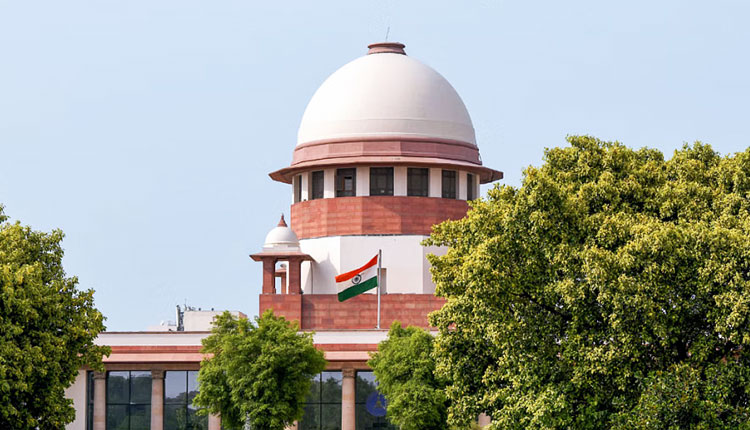
New Delhi: The Supreme Court on Friday held that the use of abusive and profane language during a heated altercation, however offensive or uncivil, would not by itself amount to the offence of obscenity punishable under Section 294(b) of the Indian Penal Code (IPC), unless the words are lascivious, appeal to prurient interests and have the tendency to deprave and corrupt the minds of those exposed to them.
A Bench of Justices Sanjay Karol and Vipul M. Pancholi made the observation while partly allowing an appeal filed by a 70-year-old man convicted in a 2017 assault case arising out of a land dispute in Tamil Nadu.
In its judgment, the apex court drew a clear distinction between “obscenity” and “vulgarity”, saying that swear words and abusive expressions, though distasteful, cannot automatically attract criminal liability under Section 294(b) IPC. “Legally, obscenity is not synonymous with ‘vulgarity’, ‘abuse’ or ‘profanity’. Use of mere swear words, profanities and vulgar expletives, however distasteful or uncivil they may be, cannot be equated with obscenity,” the Justice Karol-led Bench observed.
Explaining the legal test, the top court said that an utterance would qualify as obscene only if it was lascivious, appealed to prurient interests, had the tendency to deprave and corrupt impressionable minds, and caused annoyance to others. “Words which are merely vulgar or abusive may evoke a feeling of disgust, revulsion or shock, but that by itself does not make them obscene in law,” it added.
In its judgment, the Supreme Court recorded that the appellant had allegedly used abusive expressions, including profanities, during the altercation. However, even if the allegations were accepted in their entirety, the words could only be described as abusive or vulgar and did not satisfy the ingredients of Section 294(b) IPC.
“Such words, howsoever abusive, unpalatable or uncivil, do not satisfy the requirement of Section 294(b) IPC… Further, it is nobody’s case that the use of such words caused annoyance to others in a public place, which is a mandatory ingredient of the Section,” the judgment said while setting aside the conviction under Section 294(b).
The apex court also quashed the appellant’s conviction under Section 506(ii) IPC relating to criminal intimidation, holding that mere threatening words uttered during an altercation would not constitute the offence unless it was proved that they were intended to cause alarm or compel the complainant to act or refrain from acting.
“Mere use of threatening words during the course of an altercation, without the proof that it was intended to cause alarm to the complainant or to compel him to do or omit to do any act, would not be sufficient,” the Justice Karol-led Bench said.
However, the Supreme Court upheld the conviction under Section 326 IPC for voluntarily causing grievous hurt by a dangerous weapon after finding that the complainant had suffered a fractured nasal bone in the assault with a billhook.
The Justice Karol-led Bench held that the medical evidence fully corroborated the prosecution case and that the injury squarely fell within the definition of “grievous hurt” under Section 320 IPC. Taking into account that the incident stemmed from a land dispute, as well as the appellant’s age and health condition, the apex court modified the sentence from one year’s imprisonment to imprisonment till the rising of the court, subject to payment of a fine of Rs 50,000 within two months.
“We are inclined to modify the sentence to be served by the appellant till the rising of the Court on a day as may be specified by the concerned court. He shall also be liable to pay a fine of Rs 50,000. The same shall be done within a period of two months,” the apex court said.
(IANS)