





New Delhi: India’s Opposition unity has constantly been defined by a paradox of convenience where on the one hand, political parties are desperately trying to project a united front against the ruling NDA while on the other, the foundational fault lines and competing ambitions at the state level continue to expose the fragility of these alliances.
The ongoing political demonstrations over NEET paper leaks in the national Capital, largely spearheaded by the Congress, reflect the issue where Tuesday marked a day of high drama and confrontation in New Delhi.
What began as widespread demonstrations against systemic education failures and examination-paper leaks – organised by groups like the Cockroach Janta Party (CJP) – quickly transformed into a political showdown.
Amid the police crackdown on Monday that involved baton charges and tear gas, thousands of demonstrators and political workers reconvened at Jantar Mantar and surrounding areas.
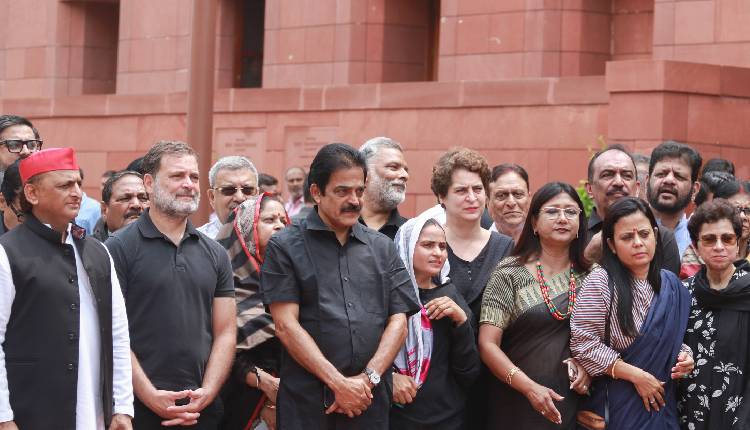
Seizing the momentum, Leader of the Opposition in the Lok Sabha, Rahul Gandhi, accompanied by Congress President Mallikarjun Kharge and other leaders like Priyanka Gandhi, led a contingent literally to Prime Minister Narendra Modi’s doorstep.
Samajwadi Party (SP) chief Akhilesh Yadav and other INDIA Bloc leaders joined this sit-in protest at Lok Kalyan Marg in a significant show of solidarity, demanding accountability and the resignation of Education Minister Dharmendra Pradhan.
This escalation ultimately resulted in the forceful removal and detention of prominent leaders, including Rahul Gandhi and Akhilesh Yadav, by the Delhi Police.
The camaraderie witnessed in Delhi masks a vastly different reality back in the states. The dynamics in the Hindi heartland, particularly regarding the crucial Uttar Pradesh Assembly elections, heavily influence SP actions.
Akhilesh Yadav’s alignment with the Congress in the national Capital is more of a strategic necessity than a heartfelt ideological merger.
For the SP and the Congress, the math of the Uttar Pradesh Assembly election necessitates a united front to combat the formidable machinery of the BJP.
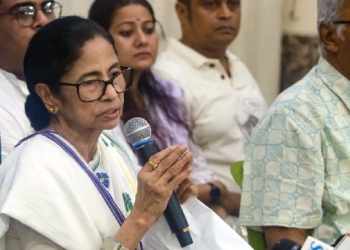
Meanwhile, Trinamool Congress leaders, who were in Kolkata on Tuesday at a demonstration commemorating those dead in a policing firing on July 21, 1993, were Wednesday morning seen among Opposition MPs protesting in Parliament on the education issue alongside Rahul and Priyanka Gandhi.
The Trinamool, which earlier mostly chose to stay away from Opposition coordination meetings in Parliament and contested elections against INDIA bloc partners including the Congress, now appears in a reconciliatory mood following their loss in this year’s West Bengal Assembly election.
Meanwhile, the narrative of Opposition unity stands shattered in the case of Punjab where the Aam Aadmi Party (AAP) and the Congress are locked in a bitter, unyielding rivalry, primarily because they are direct adversaries in the state.
Even as Akhilesh Yadav and Rahul Gandhi were sharing space in Delhi protests, AAP leaders were quick to take sharp potshots at the Congress. They view the protests not as a selfless crusade by a unified Opposition, but as a political theatre to regain national relevance.
The dichotomy highlights the central crisis facing the Indian Opposition. Soon after failing to gain from the Opposition unity in 2024 Lok Sabha election, AAP had withdrawn itself from the INDIA platform, as did the DMK following its loss in Tamil Nadu Assembly polls and the subsequent political vault by the Congress.
Thus, regional stakes dictate the INDIA Bloc to from a cohesive unit or a loose collective of competitors. As the electoral battlegrounds of Uttar Pradesh and Punjab draw closer, the political calculus will only become more complex wherein the former, the SP and the Congress are forced to work together, while in the latter case, AAP and the Congress view each other as the primary enemy.
The protests in Delhi serve as a pressure cooker where national leaders test the waters of collective mobilisation. But ultimately, regional ambitions dictate the future.
(IANS)