





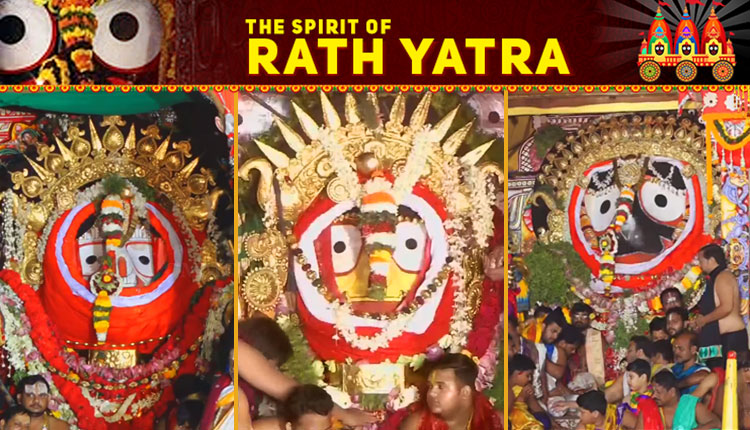
Puri: Lakhs of devotees from across India and abroad converged on the pilgrim town of Puri on Saturday to witness the sacred Suna Besha ritual, during which Lord Jagannath, Lord Balabhadra and Devi Subhadra were adorned with magnificent gold ornaments while seated on their respective chariots stationed before the Lion’s Gate of the Shree Jagannath Temple.
Observed on Ashadha Shukla Ekadashi, a day after the deities return from their annual nine-day stay at the Gundicha Temple, the Suna Besha is one of the most revered rituals associated with the Rath Yatra festival. The spectacular golden attire drew an overwhelming gathering of devotees, who queued for hours to catch a glimpse of the Holy Trinity in their resplendent form.
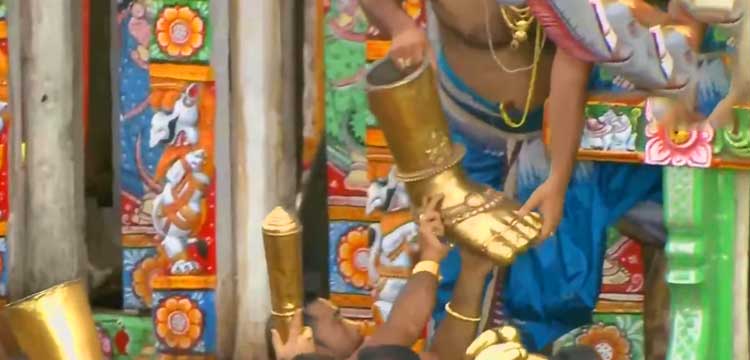
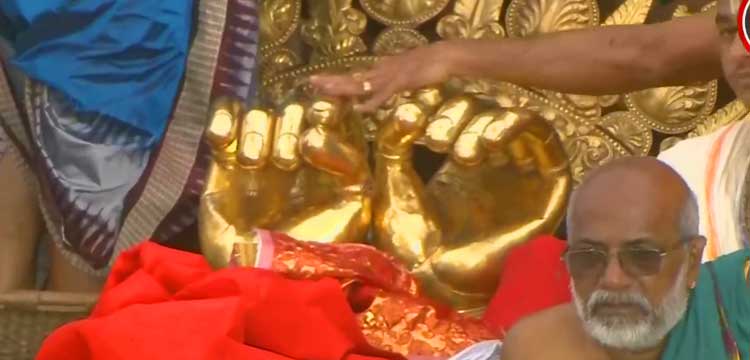
Temple sources said the deities were decorated with around 208 kg of gold ornaments and jewellery, comprising intricately crafted crowns, golden hands and feet, earrings, necklaces, peacock feathers, lotus motifs, conch, chakra, mace and other traditional ornaments. The jewellery, preserved in the outer chamber of the Ratna Bhandar treasury, was brought to the chariots under elaborate security arrangements and ceremonially handed over to the designated temple servitors for the adornment of the deities.
During the ritual, Lord Jagannath was decorated with a golden chakra in His right hand and a silver conch in His left. Lord Balabhadra was adorned with a golden plough and mace, while Devi Subhadra’s forehead was embellished with an emerald ornament, in keeping with centuries-old temple traditions.
The following is the detailed list of ornaments used during the Suna Besha. Ornaments Used in Suna Besha: Suna Hasta – Golden Hand Suna Payar – Golden Feet Suna Mukuta – Golden Crown Suna Hasta – Golden Hand Suna Payar – Golden Feet Suna Mukuta – Golden Crown Suna Mayur Chandrika – A Golden Peacock Feather Used By Shri Jagannath Suna Chulapati – A Golden Ornament Worn Traditionally On The Forehead Suna Kundal – Golden Earring Of Hanging Round Ball Type Suna Rahurekha – A Half-Square-Shaped Golden Aura Around The Deities Suna Mala – Necklaces With Several Designs Made Of Gold. These include: Padma Mala –Necklace Of Lotus Flower Sevati Mala – Necklace Of Chrysanthemum Flower Agasti Mala – Necklace Of Moon Shaped Flower Design Kadamba Mala – Necklace Of Kadamba Flower Kante Mala –Necklace Big Gold Beads Mayur Mala – Necklace Shaped As Peacock Feathers Champa Mala –Necklace Of Champak Flower Suna Chakra – Golden Wheel Suna Gada – Golden Bludgeon Suna Padma – Golden Lotus Rupa Sankha – A Silver Conch.
According to temple scholars, the Suna Besha tradition dates back to 1460 AD, when Gajapati King Kapilendra Deb is believed to have donated gold and precious ornaments to the temple following his military victories in southern India. Although the number of ornament designs used has reduced over time, the traditional craftsmanship and ritual significance have been preserved. The ornaments are periodically repaired using gold donated by devotees.
The deities are adorned in Suna Besha five times annually—once on the chariots during the Rath Yatra festivities and on four other occasions inside the Jagannath Temple during Dussehra, Kartika Purnima, Pausa Purnima and Dola Purnima.
The district administration has made extensive arrangements to facilitate the smooth movement of devotees. Multi-layered security, including armed police personnel, drones, AI-enabled surveillance cameras and advanced traffic management systems, was deployed to ensure orderly crowd movement and safeguard the priceless temple ornaments.
The sibling deities had commenced their annual Rath Yatra on July 16, travelling to the Gundicha Temple for their customary nine-day sojourn before returning on Friday during the Bahuda Yatra.
The remaining rituals of the annual festival include Adhara Pana on Sunday, followed by Niladri Bije on Monday, when the deities will ceremonially re-enter the sanctum sanctorum of the Jagannath Temple in the traditional Pahandi procession.