





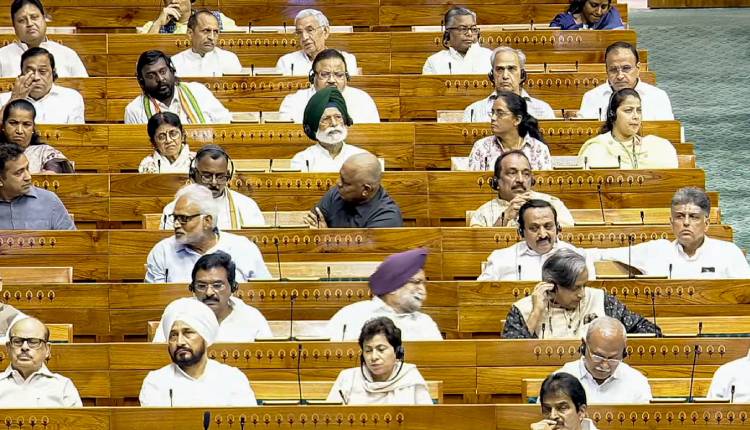
New Delhi: The Lok Sabha witnessed a political showdown on Tuesday as members debated the Public Examinations (Prevention of Unfair Means) Amendment Bill, 2026, with the government defending tougher provisions to curb paper leaks and the Opposition terming the legislation an “admission of failure” of the existing examination system.
The discussion remained inconclusive and will resume on Wednesday. According to sources, Leader of Opposition Rahul Gandhi is expected to speak around 12.30 p.m. on Wednesday.
At the outset, Lok Sabha Speaker Om Birla said six hours had been allocated for the debate and assured members that additional time could be provided if required. Parliamentary Affairs Minister Kiren Rijiju informed the House that while the Opposition had sought eight hours for the discussion, the government was willing to extend it to 10 hours.
Introduced by Union Minister of State for Personnel Jitendra Singh on Monday, the Bill seeks to amend the Public Examinations (Prevention of Unfair Means) Act, 2024. It proposes stricter punishment for examination fraud, including imprisonment of up to 10 years, fines of up to Rs 10 crore, confiscation of assets of offenders and fast-track courts mandated to deliver verdicts within three months.
The legislation comes in the wake of nationwide protests over the NEET-UG paper leak controversy that culminated in the resignation of Union Education Minister Dharmendra Pradhan.
While backing the Bill, NDA allies sought broader reforms in the examination system. Telugu Desam Party MP Lavu Sri Krishna Devarayalu urged the government to conduct NEET-UG multiple times a year, saying students should not lose an academic year because of personal emergencies. He also advocated a national question bank and regulation of coaching centres, arguing that education should not become a profit-driven sector.
Shiv Sena MP Shrikant Shinde echoed the demand for multiple examination attempts, saying it would reduce stress on students. He also called for regulating coaching institutes, alleging that many charge exorbitant fees.
The Opposition questioned whether the proposed law addressed the root causes behind repeated examination failures. Congress MP Deepender Singh Hooda praised the student protesters for conducting peaceful demonstrations, calling them “protectors of democracy”.
Congress MP K.C. Venugopal described the paper leak issue as a “crisis of hope” and alleged that the government had failed the country’s youth. He demanded that Union Home Minister Amit Shah order an SIT probe into the alleged police action against students during the Parliament March protests, arguing that the legislation would have little impact without genuine accountability.
Samajwadi Party MP Dimple Yadav also accused the police of using excessive force against peaceful student protesters and said the youth had been “stripped of their dignity”. Nationalist Congress Party (Sharadchandra Pawar) MP Supriya Sule backed the demand for an SIT investigation into the alleged police violence and urged the government to convene an all-party meeting to evolve a comprehensive, leak-proof examination framework.
Joining the debate, BJP MP Tejasvi Surya argued that the examination crisis reflected systemic problems that were being addressed through the National Education Policy, 2020. He also maintained that while the Opposition was demanding accountability from the Centre over national-level examinations, state governments must also be held responsible for irregularities in examinations conducted under their jurisdiction.
BJP MP Anurag Thakur targeted Congress leader Rahul Gandhi and Samajwadi Party chief Akhilesh Yadav, accusing them of criticising the Centre while ignoring shortcomings in states governed by their parties. He alleged that Uttar Pradesh had witnessed repeated paper leak incidents under previous Samajwadi Party governments.
Congress leader Priyanka Gandhi Vadra, meanwhile, took a swipe at Prime Minister Narendra Modi over his social media outreach, saying the government needed to connect with young people through its actions rather than presentation.
(IANS)