





Bhubaneswar: The Technical Symposium on Used Water Management, held as part of the Odisha Urban Conclave 2026 at Lok Seva Bhawan here on Sunday, called for a shift from the conventional “treat-and-dispose” approach to a “treat, reuse and recover” model for sustainable urban water management.
Housing and Urban Development Minister Dr Krushna Chandra Mahapatra, who attended the symposium as the Chief Guest, stressed the need for safe, economical and sustainable management of treated wastewater and sludge. He said wastewater should increasingly be viewed as a resource rather than merely a waste stream.
The Minister emphasised coordinated efforts among government agencies, technical institutions, practitioners and technology providers to address the growing challenges of wastewater management in rapidly urbanising areas.
H&UD Department Additional Chief Secretary Usha Padhee called for moving beyond simply treating and disposing of wastewater and focusing on its planned and safe reuse. She urged technocrats and professionals to develop practical, sustainable and scalable solutions to promote the reuse of treated water.
The symposium brought together government officials, engineers, policymakers, academics, technocrats and industry representatives to discuss wastewater treatment, reuse, sludge management, resource recovery and urban drainage.
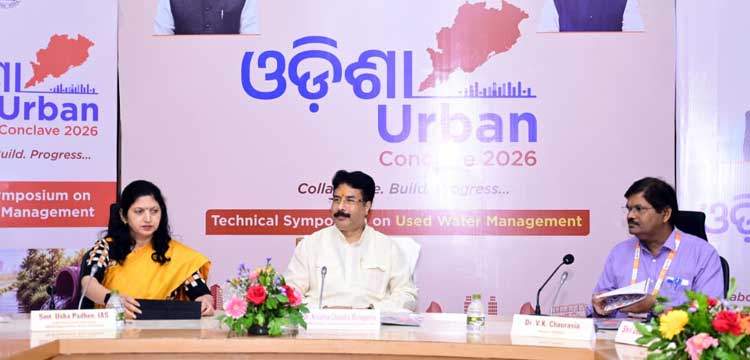
Dr V. K. Chaurasia of CPHEEO shared national perspectives on best practices, technologies and policy frameworks for used water management. Representing the Odisha government, Er Prasanta Kumar Mohapatra of the H&UD Department spoke about the State’s experience in implementing selected Sewage Treatment Plant (STP) projects and highlighted challenges in wastewater treatment infrastructure.
Experts from leading institutions also discussed emerging technologies and solutions. Dr Guruprasad Talekar and his team from IIT Palakkad presented developments in STP/FSTP sludge management and biosolids standards, while Prof Bhaskar Jyoti Deka of IIT Roorkee spoke on innovative wastewater treatment processes aimed at reuse and resource recovery.
Prof Rajesh Roshan Dash of IIT Bhubaneswar discussed emerging aerobic and anaerobic wastewater treatment technologies and their potential applications in urban areas.
Policy and planning issues related to wastewater reuse also featured prominently during the discussions. Dr Nitin Bassi of the Council on Energy, Environment and Water (CEEW) shared perspectives on policies for treated wastewater reuse, while Subrata Chakraborty of the Centre for Science and Environment (CSE) highlighted planning challenges associated with safe and effective reuse.
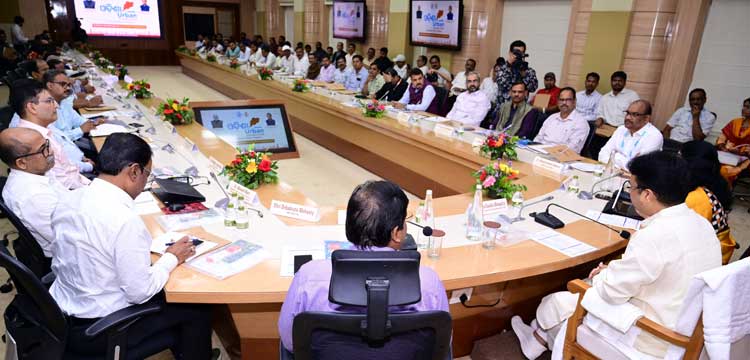
Er Abinash Roul, Engineer-in-Chief, Department of Water Resources, Government of Odisha, spoke on innovative city drainage systems and integrated urban water infrastructure.
The symposium concluded with an Industry Showcase featuring technologies and solutions for low-footprint STPs, decentralised wastewater treatment, wastewater conveyance, ETP and STP systems, aerated wetlands, in-situ lake and nala remediation, and mechanised sewer and sludge management.
The deliberations underscored the need for stronger policy support, technological innovation and collaboration among the government, academia and industry to enhance Odisha’s urban water security and promote a circular water economy.