





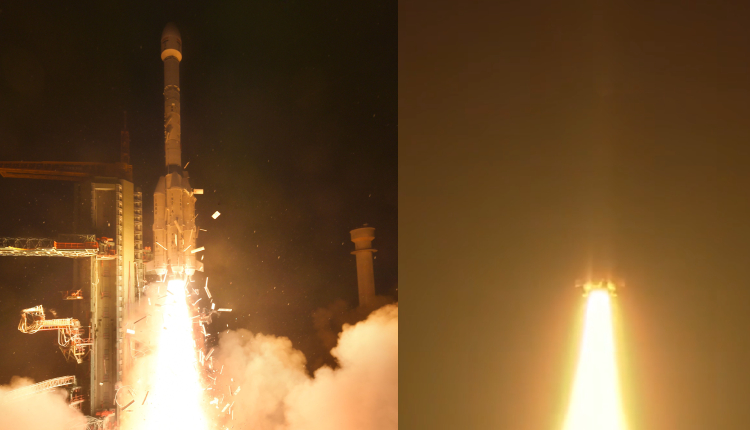
Bhubaneswar: The Indian Space Research Organisation (ISRO) on Friday successfully launched EOS-05, India’s first imaging satellite designed to operate from a geosynchronous orbit, aboard the GSLV-F17 from Sriharikota, marking a significant milestone in the country’s Earth observation capabilities.
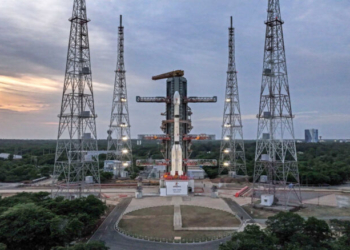
The 51.7-metre-tall, 420.5-tonne three-stage rocket lifted off from the second launch pad at the Satish Dhawan Space Centre at 2.55 am and successfully placed the approximately 2,367-kg Earth observation satellite into its intended sub-geosynchronous transfer orbit.
The mission marked the 19th flight of the Geosynchronous Satellite Launch Vehicle (GSLV) and the 107th launch from Sriharikota.
ISRO chairman Dr V Narayanan said the satellite was injected into the intended orbit precisely, underlining the improved performance of the launch vehicle.
Speaking from the Mission Control Complex after the launch, Narayanan said the GSLV had come a long way since its first flight, when it carried a payload of 1,536 kg.
“With EOS-05, the vehicle has carried the heaviest payload in its history at 2,367 kg. We gradually improved the performance of the vehicle by optimising the structural mass and improving the propulsion system,” he said.
He added that EOS-05 was India’s first dedicated imaging satellite from a geosynchronous orbit and would provide strategic data.
EOS-05 was injected into a geosynchronous transfer orbit with a nominal perigee of 171 km, an apogee of 31,026 km and an inclination of 19.28 degrees.
The satellite will subsequently be moved to its final orbit through a series of orbital manoeuvres using onboard thrusters.
The GSLV-F17 carried an S139 solid core with four L40H liquid strap-ons, a GL40HT liquid second stage and a CUS15 indigenous cryogenic upper stage. The rocket was also equipped with a four-metre composite ogive payload fairing.
The successful launch is also significant for the GSLV programme, which is designed to place heavier payloads into geosynchronous and geostationary orbits.
Friday’s mission was ISRO’s second orbital mission of 2026 and the first GSLV mission since GSLV-F16 successfully placed the joint NASA-ISRO NISAR Earth observation satellite into a 743-km sun-synchronous orbit on July 30, 2025.
The first orbital mission of 2026, PSLV-C62 carrying EOS-N1 and other payloads, had failed following an anomaly towards the end of the rocket’s third-stage flight on January 12.
Following the successful launch, ISRO posted pictures of the lift-off on X and declared the mission a success.
“Mission Success! GSLV-F17 has successfully accomplished its mission, placing EOS-05 into the intended orbit,” the space agency said.
Prime Minister Narendra Modi congratulated ISRO and described the mission as “yet another outstanding achievement” and a proud moment for the nation.
“The successful launch of GSLV-F17 carrying EOS-05, India’s first-ever imaging satellite from geosynchronous orbit, is a reflection of the excellence, innovation and growing capabilities that define India’s space sector,” Modi said in a post on X.
He also highlighted the growing partnership between ISRO and Indian industry, saying it was adding new strength and scale to India’s space programme and expanding capabilities across the space ecosystem.
Odisha Deputy Chief Minister Kanak Vardhan Singh Deo also congratulated the ISRO team on the successful launch.
“Another historic stride in India’s space odyssey! Heartfelt congratulations to Team ISRO on the successful launch of GSLV-F17/EOS-05 — India’s first imaging satellite from Geosynchronous Orbit,” he said in a post on X.
Singh Deo said the satellite would unlock advanced Earth observation across visible, infrared, multispectral and hyperspectral bands and described the achievement as a testament to India’s growing capabilities in science and innovation.