





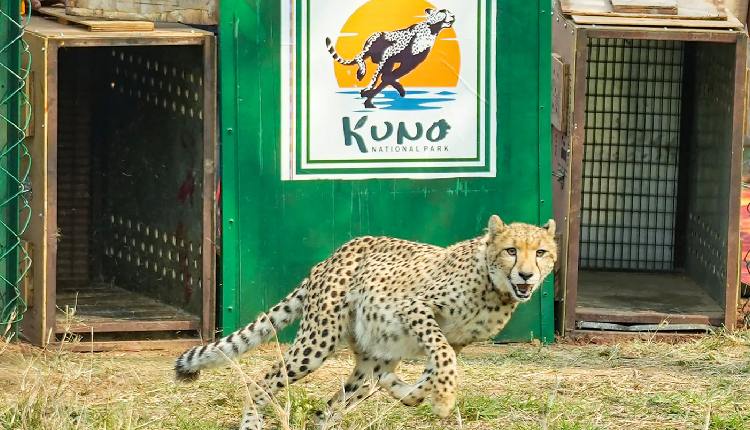
Bhopal: Four years after the first African cheetahs arrived in India, the country’s cheetah population has reached 52, with 49 animals in Kuno National Park and three in Gandhi Sagar Sanctuary. Of these, 32 are Indian-born, marking a key consolidation phase for Project Cheetah.
Prime Minister Narendra Modi introduced eight Namibian cheetahs on September 17, 2022, on his birthday, to the wilderness of Kuno National Park in Madhya Pradesh. Three survived along with 22 of their Indian-born offspring, taking the Namibian-origin population and progeny to 25. Of the 12 South African cheetahs brought on 18 February 2023, eight survive with 10 Indian-born offspring, totalling 18 (15 in Kuno and three in Gandhi Sagar). Nine cheetahs from Botswana were introduced on February 28, 2026.
Project Cheetah Director Uttam Kumar Sharma has described the process as one of constant learning, adaptation, setbacks and recovery in his “Four Years of Cheetahs in India – A Status Review”. Four years on, the establishment of breeding females and survival of second-generation cubs signal that India’s cheetah reintroduction has moved from crisis management into a phase of consolidation. In Kuno, 17 cheetahs (10 males and 7 females) are free-ranging in the wild, while 32 (5 males, 8 females and 19 cubs under one year) remain in soft-release enclosures with natural prey.
The journey has been marked by distinct phases. The difficult first year tested the project severely. Between March and August 2023, six introduced cheetahs and three of the first four Indian-born cubs were lost. Yet the lone surviving cub, abandoned by her mother and widely expected to die, is today known as Mukhi — herself a mother of five healthy cubs.
During the crisis, the Kuno team captured 12 cheetahs and returned them to enclosures in just 10 days. The dramatic 21-day search for Nirva, a South African female whose collar failed during the monsoon, ended successfully when she was found alive. These experiences forged a resilient team and the confidence that would carry the project forward, the review said.
The second year brought successful breeding, with 13 cubs surviving beyond one year. In the third year, cheetahs were released into the wild and monitored around the clock across an inter-state landscape covering 12 districts; they navigated and survived. The fourth year has been one of establishment; the animals are increasingly displaying natural behaviour, and the programme is expanding to additional sites.
(IANS)