





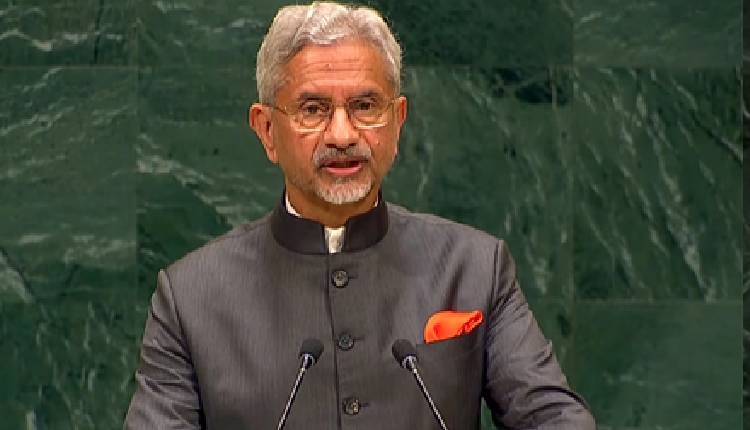
United Nations: India has defended every nation’s right to develop its own artificial intelligence models as countries at the UN warned that control over the technology must not remain concentrated among a few governments and corporations.
External Affairs Minister S. Jaishankar told the UN General Assembly that AI could become “a transformational driver” of human empowerment and economic prosperity.
He also cautioned that the misuse of AI was sharpening bias and eroding mutual respect. Countries should be free to create their own models in line with their national priorities, Jaishankar said during the General Debate on Saturday.
His remarks were part of a wider discussion at the UN over who controls AI, who writes its rules and whether developing countries will have a meaningful role in shaping the technology.
Malaysia warned that nations in the Global South could not be reduced to hosting infrastructure while governments and companies elsewhere controlled the technology.
“The Global South cannot simply become a destination for data centres while decisions about AI are made elsewhere,” Malaysian Foreign Minister Mohamad Haji Hasan said.
Developing countries must become “partners in innovation, not merely customers and markets”, he said.
Hasan said a small number of private actors now had considerable influence over how billions of people communicate, work, conduct transactions and receive information. The benefits of AI were enormous, he said, but so were the risks.
He also called for attention to the demands that data centres and other technology infrastructure place on water, energy and land. Those costs should not be imposed on developing countries while the principal economic gains flow elsewhere.
Germany raised a related concern about the concentration of AI ownership.
German Foreign Minister Johann Wadephul said most global AI patents were held by companies in only two major countries. “Whenever power becomes global, responsibility must become global, too,” he said.
Wadephul urged countries to agree on common safety requirements for the most capable AI models. The technology was advancing faster than international institutions were responding, he warned.
“AI is not waiting for our institutions to catch up. Our institutions have to catch up with reality,” he said.
Belize Prime Minister John Briceño said AI could improve public services and widen access to knowledge if governed properly.
“Poorly governed, it can deepen inequality, expose critical systems, displace workers and leave developing countries dependent on technologies and rules designed elsewhere,” Briceño said.
National legislation alone could not regulate technology that crossed every border, he added.
Singapore Foreign Minister Vivian Balakrishnan described AI as “the most urgent frontier”. He called for investments in science, infrastructure and skills, alongside safeguards that would keep people in control of the technology.
Laos said AI must support human development, build local technical capacity and respect national development priorities. Saudi Arabia highlighted its work to establish an international network of AI capacity-building centres and an AI research and ethics centre in Riyadh.
Cameroon also called for technological advances to benefit all humanity. It linked access to new technology with wider demands for reform of the international financial system so that developing countries receive a fair opportunity.
The UN adopted the Global Digital Compact in 2024 as part of efforts to encourage international cooperation on AI, close digital divides and promote safe and human-centred technology. Governments are still debating how global principles should be translated into enforceable rules.
–IANS