





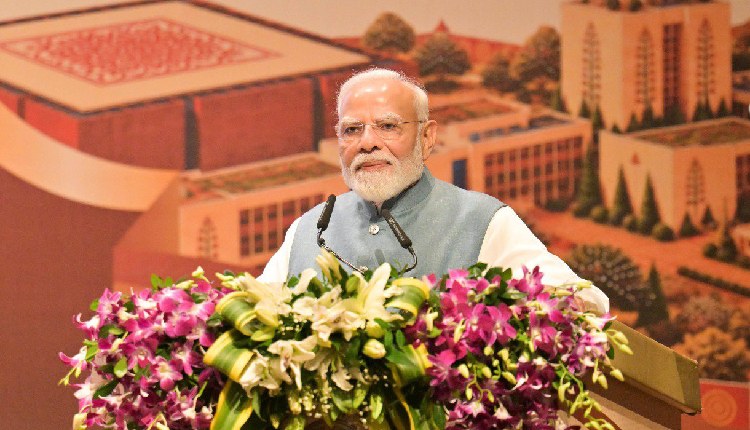
Bhubaneswar: Prime Minister Narendra Modi on Sunday emphasised the need for inclusive development, saying his government was focused on prioritising development, expanding its reach and ensuring that its benefits reached the last person.
The Prime Minister was speaking at the inauguration of the Reserve Bank of India’s (RBI) Data Centre and Cybersecurity Training Institute in Bhubaneswar.
Inaugurating the complex, Modi said, “With the blessings of Mahaprabhu (Lord Jagannath), Bhubaneswar is giving a new institution to a new India today.”
Describing the occasion as significant, the Prime Minister said the institutions would benefit Odisha and the people of the country.
In his address, Modi said that although major cities and institutions, hospitals and airports had developed after Independence, a large part of the country continued to lack basic amenities.
He added that ensuring the benefits of development reached every region and every citizen equally remained a major challenge.
He said his government, through a model of pro-people, proactive and good governance, aimed to instil confidence in every citizen that no one would be left behind in the country’s development journey.
Citing the lack of access to banking services as an example, Modi said, “Banks were nationalised in the 1960s and 1970s in the name of the poor. Yet, until 2014, more than half of the country’s population remained outside the banking system. Even bank loans were a distant dream for the middle class, while the poor, small farmers, landless people, sisters and daughters could not even think of accessing such facilities. Today, digital banking in India has connected everyone to 24-hour banking services.”
The Prime Minister also criticised the phone banking model under the previous Congress-led United Progressive Alliance (UPA) government, alleging that it benefited the wealthy and those with links to Congress leaders, while the poor were deprived of basic banking services.
“Poor and middle-class families needed a guarantor just to open a bank account, yet under the Congress’s phone banking system, thousands of crores of rupees were readily available to the rich. It was this mismanagement that brought India’s banking system under the grip of non-performing assets (NPAs), pushing it to the brink of ruin,” he alleged.
Modi also highlighted the achievements of various measures and schemes implemented by the Union government to ensure easy and hassle-free access to banking services for the poor and underprivileged sections of society.
Emphasising the need to strengthen banking security and efficiency, the Prime Minister said, “Friends, the past decade was about taking banking services to those who had been deprived of them. The coming decade is about making banking more efficient and trustworthy. The new data centre in Odisha is also going to play a major role in this. To keep the banking system secure, we must also protect its digital infrastructure. This requires strong data centres and robust computing systems.”
He added that as cyber threats continued to evolve, addressing emerging challenges required modern infrastructure, updated training systems and tools, and skilled human resources. In this context, he said, the new Cybersecurity Training Institute was particularly significant.