





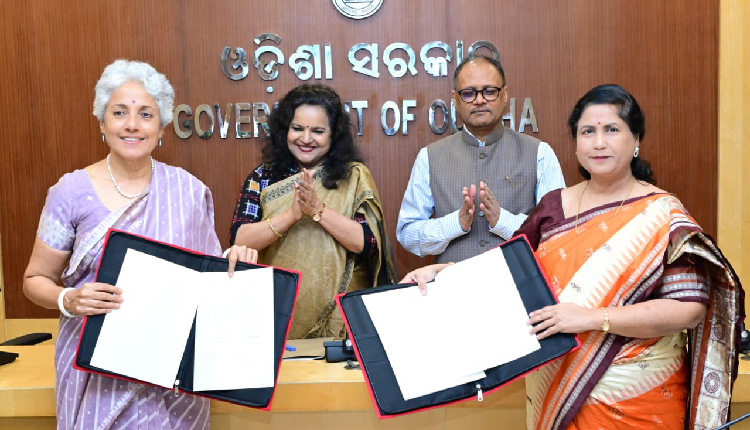
Bhubaneswar: The Odisha government has signed a five-year Memorandum of Understanding (MoU) with the M. S. Swaminathan Research Foundation (MSSRF) to promote sustainable and climate-resilient agriculture, strengthen nutrition security, conserve biodiversity and improve the livelihoods of rural and tribal communities, officials said on Tuesday.
Under the agreement, MSSRF will serve as the Technical Knowledge Partner to the state government and provide technical support to various departments in policy formulation, programme design, research, capacity building, innovation and the scaling up of development initiatives.
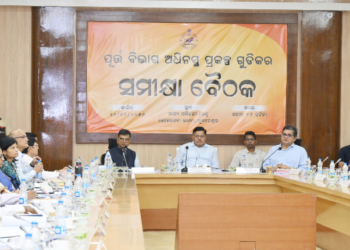
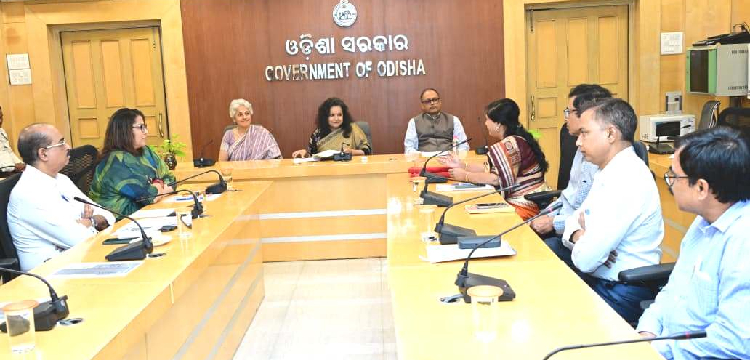
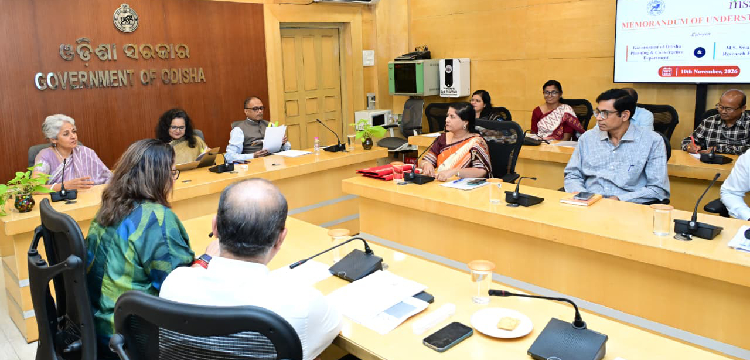
The MoU was signed at Lok Seva Bhawan in the presence of Chief Secretary Anu Garg, Development Commissioner-cum-Additional Chief Secretary Deoranjan Kumar Singh, and senior officials from various departments.
Subhashree Nanda, Additional Secretary in the Planning and Convergence Department, signed the agreement on behalf of the state government, while MSSRF Chairperson Dr Soumya Swaminathan signed it on behalf of the foundation.
The partnership will integrate scientific research, traditional knowledge and government policies across agriculture, nutrition, health, environment and livelihood sectors.
The key areas of collaboration include climate-resilient agriculture, agroecological farming practices, promotion of millets and alternative crops, conservation of traditional seeds and agricultural biodiversity, and development of sustainable food systems.
The initiative will also focus on strengthening the participation of women farmers through economic empowerment, entrepreneurship development and improved market linkages.
Under the state’s ‘Subhadra First’ approach, the partnership aims to connect women and socio-economically vulnerable households with sustainable livelihood opportunities.
The collaboration will further promote biodiversity management, environmentally sustainable agriculture and natural resource conservation through the establishment of Bio-Happiness Centres at agricultural universities.
Special emphasis will be given to improving nutrition and healthcare security, strengthening local food systems and generating livelihood opportunities in tribal-dominated and remote areas.
In the fisheries sector, the partnership will support the improvement of the ‘Fisher Friend’ mobile application, expansion of digital services, better preservation of fish products, development of value-added products and promotion of entrepreneurship among women.
The initiative also envisages joint efforts to conserve and restore water bodies and ecosystems.
In wetlands, mangrove areas and coastal regions vulnerable to distress migration, the collaboration will focus on creating local livelihood opportunities, promoting agriculture and allied activities, developing skills, strengthening enterprises run by women’s Self-Help Groups (SHGs) and improving market linkages.
These interventions are expected to enhance local employment and income opportunities while reducing vulnerabilities associated with distress migration.
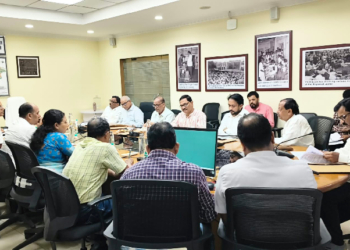
A Steering Committee chaired by the Development Commissioner will be constituted to monitor the implementation of the MoU and review its progress. Secretaries of the concerned departments and representatives of MSSRF will be members of the committee, which will meet regularly to assess progress and outcomes.
Speaking on the occasion, Swaminathan said the partnership would further strengthen the foundation’s relationship with Odisha and create opportunities for collaborative efforts towards the sustainable management of natural resources.
She said the collaboration would focus on innovation, green technologies, gender equality, women’s empowerment, promotion of millets and development of food-processing technologies to address developmental challenges.
Chief Secretary Anu Garg said signing an MoU with a reputed institution like MSSRF was a matter of pride for the state.
She described the partnership as an important step towards science-based, inclusive and sustainable development in Odisha and said the foundation, as the Technical Knowledge Partner, would support evidence-based interventions in agriculture, nutrition, biodiversity conservation and livelihoods.
Garg expressed confidence that the five-year partnership would strengthen coordination among departments and help develop scalable and practical solutions for the overall development of the state and the welfare of its people.