





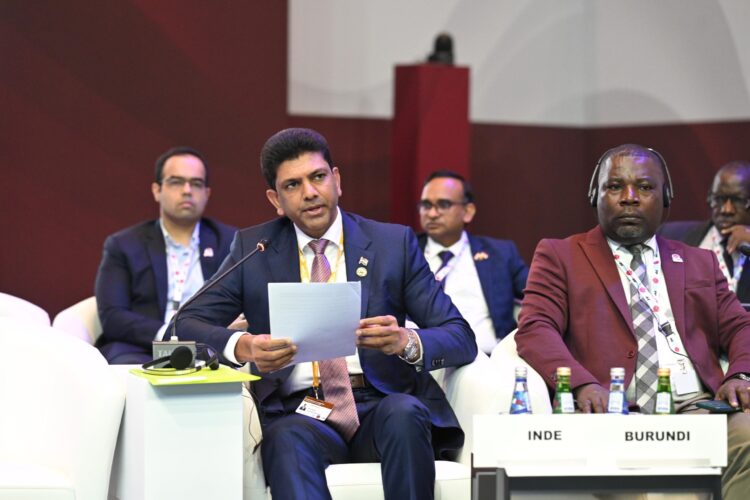
New Delhi: Calling for a more inclusive global technology governance framework, Dr. Chandra Sekhar Pemmasani, Union Minister of State for Communications and Rural Development, on Wednesday said developing countries should have a greater say in framing international technology standards and spectrum policies, while highlighting India’s advances in digital connectivity, artificial intelligence, quantum research and 5G innovation at the International Telecommunication Union (ITU) Plenipotentiary Conference (PP-26) in Doha.
Addressing a high-level discussion on emerging technologies, the minister outlined India’s efforts to make technology accessible and affordable under the leadership of Prime Minister Narendra Modi.
He noted that while around 2.2 billion people globally remain without internet access, India has invested nearly $15 billion in the BharatNet programme to expand broadband connectivity to rural regions.
“Under PM Narendra Modi, India is democratising technology: affordable AI compute for our innovators, AI models in Indian languages, quantum research hubs, and 100 5G labs building talent for the future,” he stated.
“With a modern regulatory framework and the Bharat 6G Vision, we are preparing for a future where telecom networks, AI and satellites converge, so that connectivity reaches every remote corner. Called for global cooperation on standards, spectrum and capacity building, so developing nations shape these technologies, not merely adopt them,” the minister added.
Pemmasani also highlighted the role of Samriddh Gram Centres, a winner of the World Summit on the Information Society (WSIS) Prize, in delivering essential services to rural communities.
Through these centres, villagers can access healthcare services, agricultural advisory support, banking facilities and government certificates.
“Cyber threats do not respect borders, and neither should our cooperation. Learning from each other’s best practices makes all of us stronger,” he stated.
The minister further showcased India’s initiatives in affordable artificial intelligence computing, indigenous language AI models, quantum technology research and the establishment of 100 5G use-case laboratories.
He called for greater participation by developing nations in shaping global technology standards and spectrum management policies.
(IANS)