





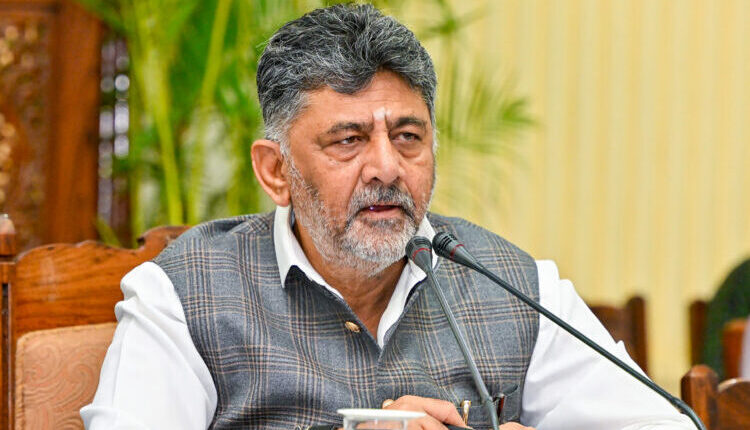
Bengaluru: Karnataka Chief Minister D.K. Shivakumar on Saturday hit back at Tamil Nadu Congress President Manickam Tagore for criticising him over the Mekedatu project, asserting that Karnataka has every right to build the proposed dam and that he was least bothered by political condemnation. He also extended an invitation to leaders from Tamil Nadu to visit Karnataka to understand how the project would benefit them.
Congress MP Manickam Tagore has triggered an intra-party controversy by opposing the proposed Mekedatu balancing reservoir project across the Cauvery river and criticising Karnataka Chief Minister D.K. Shivakumar. The Congress government in Karnataka has projected the Mekedatu project as one of its flagship initiatives.
Tamil Nadu Congress Committee (TNCC) President Manickam Tagore strongly condemned Chief Minister Shivakumar’s remarks on the proposed Mekedatu dam project, describing the construction as not only illegal but also a serious threat to the interests of farmers in Tamil Nadu.
Responding to questions from the media in Bengaluru, Chief Minister Shivakumar said Tamil Nadu leaders should understand the benefits of the project and invited a delegation from the neighbouring state to visit Karnataka to understand how it would benefit them.
“Let anyone condemn me. I am least bothered. It is my state and my right. They should also understand this. Let them come with a delegation. I will show them and explain how the project will help them,” he said.
The Chief Minister said the issue was being viewed through a political lens in Tamil Nadu, where different parties were criticising Karnataka for political reasons.
“I don’t mind it. It is a matter of politics there. If the Congress does not condemn, the DMK will condemn. If the DMK does not condemn, the AIADMK will condemn. At the end of the day, everyone condemns,” he said.
Questioning the opposition to the project, Chief Minister Shivakumar said all states must respect the law of the country and abide by the Supreme Court’s directions on sharing Cauvery water.
“Why are they not accepting the law of this country? Everyone has to accept the law. The law is the same for everyone in this country,” he said.
He maintained that Karnataka would protect Tamil Nadu’s legitimate share of Cauvery water, while asserting that the state also had the right to construct the Mekedatu balancing reservoir.
“The Supreme Court has stated that about 170 TMC of water is Tamil Nadu’s right, and we will protect their right. It is our duty. It is also our right to build the dam and give them water,” Chief Minister Shivakumar said.
He added that Tamil Nadu leaders were aware of the facts concerning the project and said the matter could be discussed in detail at a later stage.
The Mekedatu Balancing Reservoir and Drinking Water Project is a proposed multi-purpose project by the Government of Karnataka across the Cauvery River to be built near Mekedatu (meaning ‘Goat’s Leap’) in Ramanagara district, Karnataka, at the confluence of the Cauvery and Arkavathi rivers, roughly 90–100 km from Bengaluru and close to the Tamil Nadu border.
The proposed Mekedatu balancing reservoir project aims to provide 4.75 TMC of drinking water annually to the Bengaluru Metropolitan Region and surrounding areas, besides generating around 400 MW of hydroelectric power.
It is also envisaged as a balancing reservoir to regulate surplus monsoon flows and help ensure the release of Tamil Nadu’s allocated share of 177.25 TMC of Cauvery water, including during distress years. Karnataka maintains that the project is entirely within its territory and will neither violate the Supreme Court’s water-sharing orders nor affect Tamil Nadu’s allocated share, while arguing that it is essential to meet Bengaluru’s growing drinking water requirements.
However, Tamil Nadu has strongly opposed the project through legislative resolutions and legal challenges, arguing that an upstream reservoir would give Karnataka control over river flows and could affect irrigation in the Cauvery delta. It has also contended that prior consent from riparian states and statutory authorities is necessary. The project also faces environmental concerns as it involves the submergence of more than 5,000 hectares of land within the Cauvery Wildlife Sanctuary.
(IANS)