





Tokyo: India and Japan on Thursday unequivocally and strongly condemned terrorism and violent extremism in all its form and manifestations, including cross-border terrorism, and called for action against all United Nations-listed terrorist groups and entities.
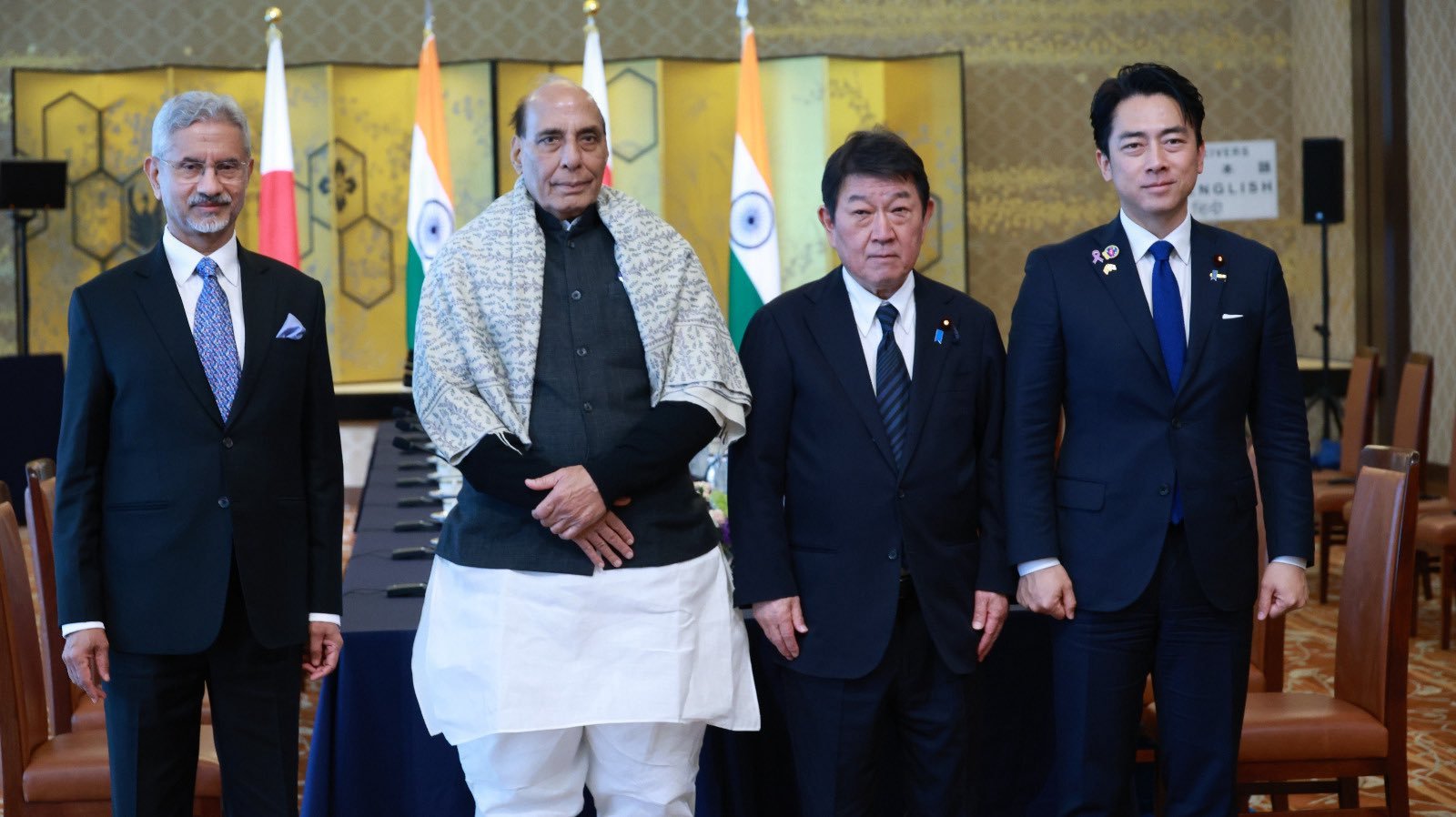
The Joint Statement issued after Defence Minister Rajnath Singh and External Affairs Minister (EAM) S Jaishankar co-chaired the fourth India-Japan 2+2 Foreign and Defence Ministerial Meeting with Japanese Minister of Foreign Affairs Toshimitsu Motegi and Minister of Defence Shinjiro Koizumi in Tokyo on Thursday called for concerted actions against all UN-listed terrorist groups and entities, including Al Qaeda, ISIS/Daesh, Lashkar-e-Tayyiba (LeT), Jaish-e-Mohammad (JeM) and their proxies, and to take resolute actions to root out terrorists’ safe havens, eliminate terrorist financing channels and its nexus with transnational crime, and halt cross-border movement of terrorists.
The ministers reiterated their commitment to reform the United Nations Security Council (UNSC), including expansion in both permanent and non-permanent categories, which a majority of Member States support, to better reflect the current geopolitical realities. They expressed their mutual support for each other’s candidatures for a permanent seat in a reformed UNSC. They also expressed appreciation for India and Japan confirming mutual support for respective candidatures to non-permanent seats in the years 2028-29 and 2033-34.
“Recognising the synergies between India-Japan bilateral cooperation and the Quad’s four priority areas, namely maritime and transnational security, economic prosperity and security, maritime and transnational security, critical and emerging technologies, and humanitarian assistance and emergency response, the Ministers underscored their commitment to leveraging bilateral cooperation to complement and reinforce Quad initiatives and deliver tangible benefits to partners across the Indo-Pacific,” the Joint Statement read.
The ministers welcomed the holding of a series of Quad Foreign Ministers’ Meetings as well as the Quad Leaders’ Summit held in November. They highlighted the importance of cooperation with ASEAN member states to strengthen regional resilience and promote peace, stability and prosperity and welcomed the first India-Japan-Philippines Trilateral 1.5 Dialogue and the first trilateral naval PASSEX exercise involving India, Japan and Indonesia.
Considering the increasing incidence of cyberattacks, the ministers agreed on the need to strengthen cybersecurity cooperation, including on Artificial Intelligence (AI)-enabled cybersecurity and the security of AI systems, with particular attention to critical infrastructure. They directed their teams to renew the existing Memorandum of Cooperation in Cybersecurity and convene the next edition of the India-Japan Cyber Dialogue at an early date, according to the joint statement.
The ministers reaffirmed their commitment to strengthening secure and resilient digital connectivity in the Indo-Pacific. They agreed to enhance bilateral cooperation in developing trusted, redundant and high-speed undersea cable networks, including through industry partnerships, and share best practices for ensuring the security, reliability and resilience of critical undersea communications infrastructure.
“Ministers underscored the growing strategic convergence and trust between the two countries in an increasingly complex and uncertain international environment and stressed the importance of closer coordination under the India-Japan Special Strategic and Global Partnership in addressing present geopolitical, economic and security challenges,” the joint statement reads.
“As leading democracies and major economies of the world, the Ministers reaffirmed their commitment to maintaining and strengthening an international order which is free, open and based on the rule of law, respect for principles of national sovereignty and territorial integrity, and peaceful resolution of disputes without resorting to threat or use of force. They underlined the need for all countries to refrain from any attempt to unilaterally change the status quo,” the Joint Statement added.
The ministers appreciated and committed to enhancing the synergy between the Indo-Pacific Oceans’ Initiative (IPOI) and Mutual and Holistic Advancement for Security and Growth Across Regions (MAHASAGAR) and the updated ‘Free and Open Indo-Pacific (FOIP)’ that contributes to a peaceful, prosperous and resilient Indo-Pacific.
(IANS)