






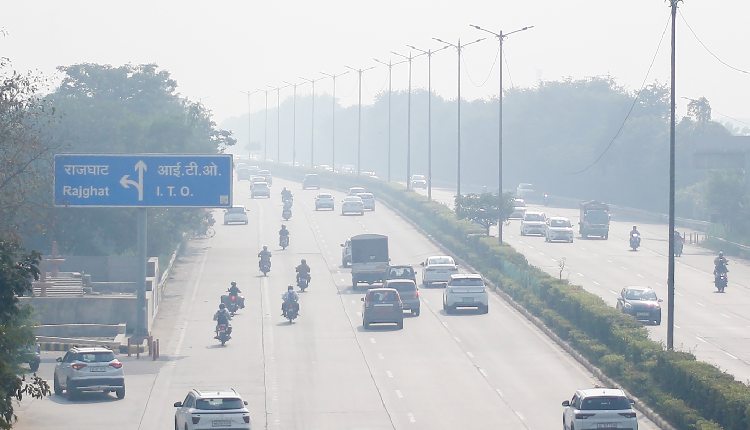
New Delhi: Delhi’s air quality remained in the ‘poor’ category on Monday, with the city recording an Air Quality Index (AQI) of 236 at 8 a.m., according to real-time data from the Central Pollution Control Board (CPCB). PM2.5 continued to be the prominent pollutant.
Several monitoring stations across the national Capital recorded AQI levels in the ‘poor’ category, while some locations reported ‘very poor’ air quality.
The AQI readings at various monitoring stations were Burari (239), Karala (245), Nangloi (229), Maidan Garhi (237), Ghummanhera (253), Chhawla (272), Uttam Nagar (276), NIH Narela (256), Talkatora Garden (317), Aya Nagar (296), CRRI Mathura Road (296), Punjabi Bagh (283), Shadipur (288), Pusa (196), Sirifort (333), Commonwealth Sports Complex (293), JNU (288), Burari Crossing (295), North Campus (281), R.K. Puram (254), ITO (301), Anand Vihar (236), DTU (271), Mundka (279), Sri Aurobindo Marg (244), Jahangirpuri (272), Rohini (253), Bawana (275) and Narela (240).
The development comes as the Commission for Air Quality Management (CAQM) has unveiled a stricter accountability framework aimed at reducing pollution levels across the National Capital Region (NCR) by 15 to 20 per cent in 2027.
Despite the ‘poor’ air quality readings, Delhi Chief Minister Rekha Gupta has alleged that the national Capital’s overall air quality has shown considerable improvement compared to the situation a decade ago.
According to the latest available forecast from the Air Quality Warning and Integrated Decision Support System for Emissions – Delhi (AIRWISE-Delhi), the city’s air quality is likely to remain in the ‘poor’ category from Monday to Wednesday. There is also a possibility of AQI levels fluctuating between the ‘poor’ and ‘very poor’ categories over the subsequent six days.
Meanwhile, Stage II of the Graded Response Action Plan (GRAP) remains in force across Delhi-NCR. The measures under this stage include mechanised road sweeping, dust suppression, water sprinkling and stricter enforcement of dust-control norms at construction sites. Restrictions on the use of personal vehicles are also part of the measures aimed at curbing pollution.
In a significant move towards addressing the issue in the long term, the CAQM has directed the governments of Delhi and neighbouring NCR states to prepare comprehensive and outcome-oriented State Action Plans for 2027.
The Commission has outlined four key requirements for these plans. For the first time, states have been asked to prepare dedicated district-level action plans as an integral part of their broader pollution-control strategies.
The framework also introduces measurable pollution-reduction targets instead of merely listing activities. States will be required to ensure a minimum 15 per cent reduction in the overall pollution load, with an ambitious target of achieving up to 20 per cent.
To ensure accountability, the plans will identify officers by their names and ranks, assigning them direct responsibility for implementing the measures and achieving the stipulated targets.
Additionally, the CAQM will prescribe supplementary interventions based on previous enforcement data and emerging environmental challenges. State governments will be required to incorporate these measures into their final action plans.
(IANS)