





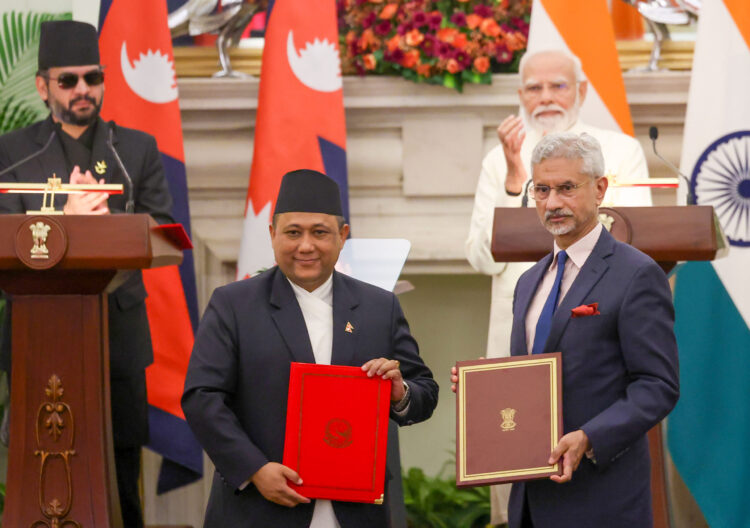
Kathmandu: Nepal and India on Monday unveiled a 10-pillar joint vision aimed at reshaping their bilateral partnership and providing a roadmap for future cooperation.
The 10 pillars of the joint vision cover economic and development cooperation, physical and digital connectivity, energy and water resources, climate resilience, good governance, technology and innovation, education and skills development, sports, culture and tourism, health, and agriculture.
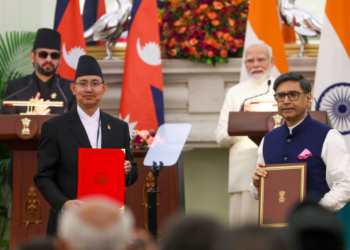
Titled ‘Viksit Bharat and Samunnat Nepal: Re-imagining the Partnership’, the joint vision was adopted during Nepali Prime Minister Balendra Shah’s two-day State Visit to India at the invitation of his Indian counterpart, Prime Minister Narendra Modi.
The first pillar of the joint vision document is ‘Comprehensive Economic and Development Partnership’. Under this pillar, the two countries agreed to review existing frameworks and agreements governing trade and investment to facilitate a more comprehensive economic partnership. They will also explore new transit connectivity arrangements and air routes to improve access between the two countries.
The document states that India’s national vision of ‘Viksit Bharat 2047’ and Nepal’s aspiration of ‘Samunnat Nepal’ have several complementarities that could be leveraged to further strengthen the extensive economic ties between the neighbouring countries.
Under this pillar, the two countries will cooperate in establishing cross-border special economic zones and industrial parks near the Nepal-India border. These zones are expected to promote export-oriented manufacturing and strengthen links with regional supply chains in manufacturing and other processing industries.
Under the second pillar, titled ‘Physical and Digital Connectivity’, the two sides will also cooperate in developing information technology parks, while India will encourage investment in Nepal’s priority sectors.
The joint vision document says that arrangements will be pursued to enhance investor confidence and improve the ease of doing business in Nepal.
Nepal and India have agreed to accelerate several cross-border connectivity projects, including railway links, integrated check posts, petroleum pipelines and digital payment systems, with a view to strengthening economic cooperation and people-to-people ties.
The third pillar is ‘Energy, Water Resources and Climate Resilience’. The two countries have agreed to strengthen cooperation in hydropower development, cross-border electricity trade, water resources management and climate resilience, with a focus on promoting investment, accelerating multipurpose projects and improving disaster preparedness.
Good Governance is the fourth pillar of the joint vision document. Under this pillar, the two countries have agreed to strengthen cooperation through the exchange of digital technology, technical expertise and best practices, while expanding training opportunities for civil servants and cooperation between government institutions.
Under the agreement, India and Nepal will exchange technical expertise and best practices in digital public infrastructure, covering digital identity, payment systems and e-governance. Such cooperation will be pursued in accordance with globally recognised principles of digital sovereignty and data protection and will support the implementation of Nepal’s Digital Nepal Framework.
The fifth pillar is ‘Technology, Space and Innovation’. Under this pillar, the two countries have agreed to deepen cooperation in technology, innovation and space research, including plans to establish a Startup Centre of Excellence in Kathmandu and a Digital Nomads and Innovation Hub in Pokhara, in western Nepal.
The sixth pillar is ‘Education and Skill Development’. Under this pillar, the two countries have agreed to strengthen cooperation in education and skill development, including exploring the establishment of a branch campus of an Indian Institute of Technology (IIT) in Nepal and expanding scholarship opportunities for Nepali students in emerging academic disciplines.
Sports is the seventh pillar of the joint vision. Nepal and India have agreed to strengthen cooperation in sports development, including establishing a national cricket coaching and training academy in Nepal with Indian support and expanding opportunities for Nepali players to train in India.
Under the agreement, India will support the establishment of a national cricket coaching and training academy in Nepal, alongside the development of cricket infrastructure at both national and provincial levels.
Players from Nepal’s provincial cricket teams will also be given opportunities to train at national cricket training academies in India.
Nepal and India have agreed to strengthen cultural and tourism cooperation by developing cross-border religious tourism circuits, organising annual youth cultural festivals and promoting collaboration between universities and tourism entrepreneurs.
These initiatives are outlined under the eighth pillar, titled ‘Culture and Tourism’. The two countries will work together to develop religious tourism circuits and new destinations by linking important cultural and pilgrimage sites in both countries.
The proposed initiatives include a Ramayana circuit connecting Janakpur in Nepal with Ayodhya in India; a Buddhist circuit linking Lumbini, Bodhgaya, Sarnath and Kushinagar; and a Shiv-Shakti circuit connecting Kathmandu’s Pashupatinath Temple with Varanasi. Sister-city agreements will also be pursued to strengthen these links.
Under the ninth pillar, ‘Health’, the two countries have agreed to strengthen cooperation in the health sector, including upgrading Nepal’s National Medical Laboratory, establishing Jan Aushadhi Kendras to provide affordable medicines and expanding healthcare infrastructure across the country.
The 10th pillar is ‘Agriculture’. Under this pillar, the two countries have agreed to strengthen cooperation in agriculture and livestock development, including establishing an agro-industrial park in Chitwan with grant assistance from India to promote value addition to Nepali agricultural products.
The proposed agro-industrial park will aim to increase the value of agricultural products by supporting processing and other value-addition activities. The document states that India will provide grant assistance for its establishment.
The two countries have also agreed to expedite the implementation of the 2026–2030 Work Plan between India’s Indian Council of Agricultural Research (ICAR) and Nepal’s Nepal Agricultural Research Council (NARC).
As part of efforts to strengthen Nepal’s agricultural and livestock sectors, India will organise specialised training programmes for Nepali government officials, farmers and other agriculture-related professionals.
The two countries have also agreed to activate a High-Level Monitoring Group to accelerate the implementation of bilateral projects and initiatives. The mechanism will meet at least once every six months.
The monitoring group will be led by Nepal’s Foreign Secretary and India’s Ambassador to Nepal. It will oversee the implementation of projects and initiatives envisaged under the joint vision document and facilitate the necessary clearances and approvals to expedite their execution.
The two Prime Ministers also agreed that the monitoring group will submit its reports to the India-Nepal Joint Commission, which is co-chaired by the foreign ministers of both countries.
(IANS)