





Rourkela: Researchers at the National Institute of Technology (NIT) Rourkela have developed an electrochemical technology to recover struvite, a slow-release fertiliser, from human urine, achieving phosphorus recovery efficiency of over 98 per cent in laboratory-scale experiments.
The technology offers a sustainable approach to recovering valuable plant nutrients from human waste while addressing challenges related to waste disposal, resource conservation and the energy-intensive production of conventional fertilisers, officials said on Monday.
The research, published in the Journal of Water Process Engineering, explores an alternative to conventional fertiliser production by recovering phosphorus and nitrogen from waste streams rather than relying entirely on industrial manufacturing processes.
Phosphorus is an essential nutrient for plant growth and one of the three major components of nitrogen-phosphorus-potassium (NPK) fertilisers widely used in agriculture to improve crop growth and soil fertility. However, manufacturing conventional fertilisers requires substantial energy and involves high production costs.
Scientists have previously investigated several methods to recover nitrogen and phosphorus from human urine. One such approach, chemical precipitation, involves adding chemicals to urine to separate and collect nutrients in solid form. However, the method requires continuous additions of alkaline chemicals and external magnesium salts, increasing chemical consumption and operational costs.
To address these limitations, the NIT Rourkela researchers developed an electrochemical process that uses electricity to initiate chemical reactions and recover nutrients without requiring external magnesium salts.
The system uses magnesium electrodes that gradually dissolve when an electric current is passed through the urine. The released magnesium ions react with other substances present in the urine to form struvite, a compound that can be used as a slow-release fertiliser.
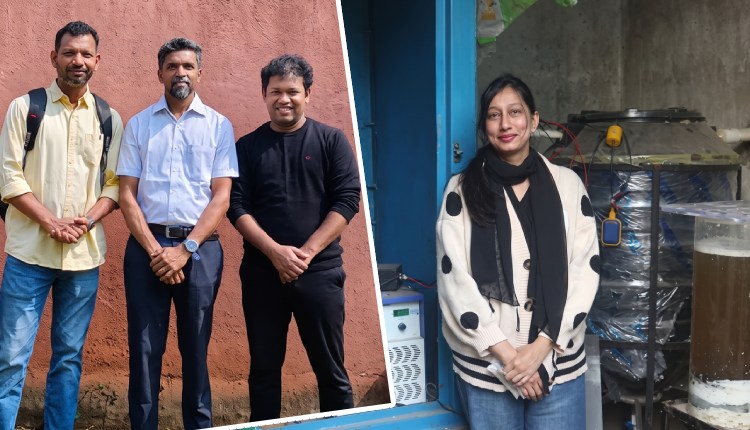
The research was co-authored by Prof. P. Balasubramanian and Prof. Sivaraman J., associate professors, and Prof. Bikash Chandra Maharaj, assistant professor, in the Department of Biotechnology and Medical Engineering, along with Alisha Zaffar, a research scholar at NIT Rourkela.
Explaining the technology, Prof. P. Balasubramanian said the electrochemical process provides a sustainable route for nutrient recovery by generating the required magnesium ions directly within the system.
“By using a sacrificial magnesium anode, we can generate the required magnesium ions in situ, eliminating the need for external chemical addition and enabling precise control over the precipitation process. This makes the technology compact, modular, and well-suited for decentralised nutrient recovery,” he said.
One of the major challenges encountered during the development of the system was the accumulation of sludge on the electrode surfaces. Such deposits interfere with electrode functioning, restrict the efficient passage of electricity and can slow down chemical reactions, reducing the overall efficiency of the process.
To overcome this problem, the researchers introduced a reverse polarisation technique, in which the direction of electric current is periodically reversed. This helps remove deposits from the electrode surfaces and ensures uniform dissolution of magnesium into the urine solution.
The team evaluated the electrochemical setup using two reactors with working volumes of five litres and 35 litres, respectively, and urine collected from male urinals.
The experiments recorded phosphorus recovery efficiencies of over 98 per cent in the five-litre reactor and over 91 per cent in the scaled-up 35-litre reactor.
The recovered material was confirmed to be pure struvite through X-ray diffraction (XRD) and Fourier-transform infrared spectroscopy (FTIR) analyses.
The researchers also assessed the fertiliser potential of the recovered struvite and found it comparable to commercially available NPK fertilisers in supporting the growth of basil, cowpea and okra.
However, the economic assessment indicated that recovering struvite alone from the 35-litre reactor was not financially viable due to high operating costs. The researchers found that integrating the process with additional nutrient recovery methods, including ammonium sulphate recovery, could improve its economic feasibility.
According to Prof. Balasubramanian, a techno-economic analysis of an integrated process scaled up to a 500-litre pilot system demonstrated financial viability, with an estimated payback period of 6.55 years and an internal rate of return of 13 per cent.
He said a multi-nutrient recovery approach would be essential to make the technology economically sustainable.
As part of the next phase of research, the team plans to focus on continuous-flow electrocoagulation systems, field trials of struvite-based fertiliser, technological upgrades for green hydrogen recovery and a comprehensive life-cycle assessment to support the practical and sustainable implementation of the technology.