





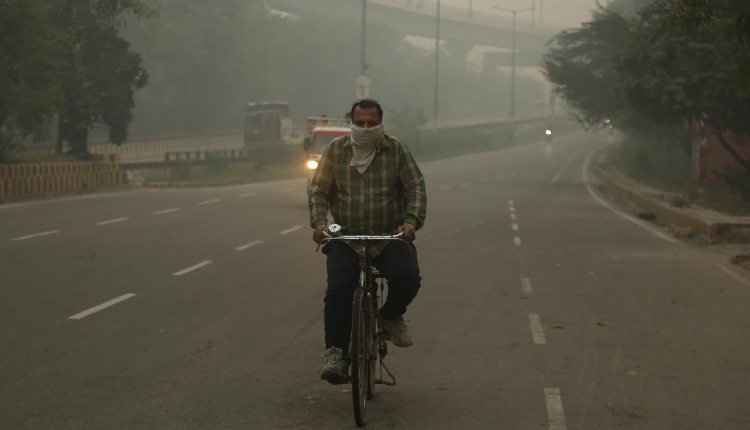
New Delhi: Delhi woke up to another polluted morning on Tuesday, with the city’s average Air Quality Index (AQI) recorded at 200 at 8 a.m., according to real-time data from the Central Pollution Control Board (CPCB). PM2.5 remained the prominent pollutant.
Several monitoring stations across the national Capital recorded poor air quality. Sirifort registered an AQI of 333, followed by IGNOU-Maidan Garhi at 330, Talkatora Garden at 319, North Campus at 322, CRRI Mathura Road at 311, Burari Crossing at 305, Commonwealth Sports Complex at 302 and IIT-Delhi at 300.
Other monitoring stations also reported elevated pollution levels, including Aya Nagar (280), Mundka (282), JNU (284), DTU (258), Bawana (258), Shadipur (256), Nehru Nagar (256), NIH Narela (250), Burari (248), Vivek Vihar (245), Ghummanhera (238), Maidan Garhi (230), Uttam Nagar (227) and Chhawla (260).
Biomass burning has remained a key point of discussion in connection with Delhi’s PM2.5 pollution. However, the latest source-apportionment estimates displayed on the Indian Institute of Tropical Meteorology’s (IITM) Air Quality Early Warning System present a more nuanced picture.
According to the system’s source-apportionment data for November 23, stubble burning accounted for just 0.8 per cent of Delhi’s daily mean PM2.5 concentration. The largest contribution came from the ‘Others’ category at 32 per cent, followed by transport emissions within Delhi at 21.5 per cent.
The estimates also attributed a significant share of pollution to sources in neighbouring districts, including Jhajjar at 10.2 per cent and Rohtak at 6.1 per cent.
Meanwhile, the Commission for Air Quality Management (CAQM) continues to keep Stage II of the Graded Response Action Plan (GRAP) in force across Delhi-NCR. Measures under this stage include intensified mechanised road sweeping, dust suppression, water sprinkling, stricter enforcement of dust-control norms at construction sites and steps to discourage the use of private vehicles.
In a separate development, CAQM Member Secretary Tarun Kumar Pithode held a review meeting with Deputy Commissioners (DCs) and District Magistrates (DMs) across Delhi-NCR and adjoining areas to assess ongoing winter pollution-control measures and District Action Plans 2027.
To ensure strict enforcement and accountability, designated officers have been assigned direct responsibility for achieving the stipulated emission-reduction targets.
In a post on X, the CAQM said the meeting emphasised the implementation of District Action Plans 2027 to reduce pollution.
Earlier, on Saturday, the CAQM began assessing and ranking Delhi and neighbouring states on their performance in implementing air pollution control measures. Its 2026 report card, covering progress up to October, highlighted significant gaps in industrial inspections, waste management, public transport and pollution-monitoring infrastructure.
(IANS)