





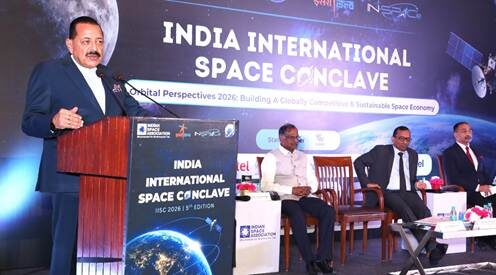
New Delhi: India’s space economy is poised for a major expansion, with its value projected to rise from nearly $9 billion at present to $40-45 billion by 2036, as private enterprises increasingly emerge as key drivers of growth in the sector, Union Minister of State (Independent Charge) for Science and Technology and Earth Sciences, Dr Jitendra Singh, said on Tuesday.
Addressing the fifth India International Space Conclave 2026 in the national capital, Singh said the country’s space ecosystem has witnessed an extraordinary transformation over the past few years, growing from a handful of startups to nearly 400-500 companies.
He attributed the growth to a series of reforms initiated by the Prime Minister Narendra Modi government that opened the space sector to private participation and encouraged innovation.
“India’s space economy, currently valued at nearly $9 billion, is set to grow to $40-45 billion in less than a decade, with the private sector driving a major transformation of the country’s space ecosystem,” the minister stated.
“India’s space ecosystem has expanded from single-digit startups to nearly 400-500 companies in just a few years, demonstrating how the reforms initiated under Prime Minister Narendra Modi have unlocked the country’s immense entrepreneurial and technological potential,” Singh noted.
The two-day conclave, organised by the Indian Space Association (ISpA), brought together industry leaders, startups, researchers and international stakeholders to discuss India’s expanding role in the global space economy. The event also saw the release of the report, Space Economy 2036: The India Blueprint.
Highlighting key policy initiatives, Singh said the establishment of New Space India Limited (NSIL), the creation of the Indian National Space Promotion and Authorization Centre (IN-SPACe), and the decision to open the space sector to private players marked a turning point in India’s space journey.
He described the reforms as among the most significant policy changes in recent decades, enabling private enterprises to enter a sector that had traditionally remained under government control.
The minister pointed to the progress of Indian space startups as evidence of the sector’s growing maturity.
He cited Skyroot Aerospace’s maiden launch vehicle flight, its multi-mission launch agreements and attainment of unicorn status, alongside advances by firms such as Agnikul, which are developing indigenous propulsion systems, rocket engines, earth-observation solutions and satellite imaging technologies.
(IANS)