





New Delhi: The son rose in the north but did not become Chief Minister, though serving as Deputy Chief Minister twice, also elected four times to the Lok Sabha, and led the Shiromani Akali Dal (SAD) for more than 15 years.
His father Parkash Singh Badal was the longest serving Chief Minister of Punjab, holding office several times between 1970 and 2017. Now, will the return of SAD as Bharatiya Janata Party (BJP) ally after six years give an opportunity to Sukhbir Singh Badal to be the Punjab Chief Minister?
Though the alliance’s electoral decline had begun with the 2017 Assembly election, the real crisis began after SAD parting ways with the BJP in 2020.
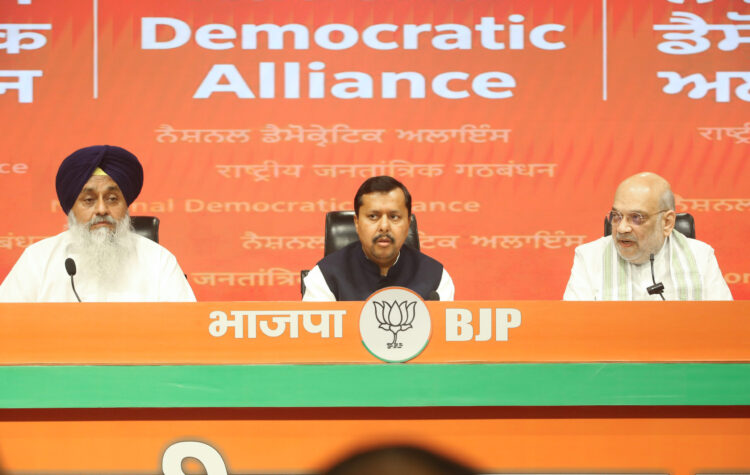
Its decision to reunite ahead of the 2027 Punjab Assembly election marks the return of one of India’s longest-running political alliances.
The partnership, which lasted from 1996 until its end in 2020 over the controversial farm laws, was built on a simple but effective electoral formula.
While the SAD mobilised rural Sikh voters, the BJP consolidated urban Hindu support.
For nearly two decades, that combination delivered some of the alliance’s biggest successes.
Available data shows the allies gained strength together.
In the 1997 Punjab Assembly election, the SAD won 75 seats and the BJP 18, giving the alliance a commanding position in the 117-member House.
Losing in 2002, the alliance returned to power in 2007 with the SAD winning 48 seats and the BJP 19.
In 2012, the coalition created history by becoming the first government after Punjab’s reorganisation in 1966 to retain power consecutively.
The SAD won 56 seats and the BJP 12, taking the alliance tally to 68 seats despite the Congress securing a larger statewide vote share.
These victories established the Badal-led alliance as Punjab’s dominant political force for much of the 2000s and early 2010s.
But after a decade in office and facing strong anti-incumbency, the SAD was reduced to 15 seats and the BJP to three in the 2017 Assembly election, leaving the coalition with only 18 seats as the Congress swept to power with 77.
Despite the setback, the alliance remained Punjab’s principal non-Congress political formation.
Meanwhile, through the wider anti-graft stir, the Aam Aadmi Party (AAP) emerged as a significant force in the state and in the 2019 Lok Sabha election, the National Democratic Alliance (NDA) tally declined to four of the state’s 13 Parliamentary seats.
And in 2020, the introduction of the three farm laws triggered widespread protests, particularly in the north.
It was then, facing significant pressure from farmers and its own rural support base, the SAD distanced itself from the legislation and walked away from the NDA, ending a 24-year partnership with the BJP.
The electoral consequences were severe for both parties.
When the 2022 Punjab Assembly election was held, the former allies contested separately with devastating results.
The AAP swept the election with 92 seats, while SAD collapsed to just three seats and the BJP managed only two.
The trend continued in the 2024 Lok Sabha election with SAD managing only the Bathinda seat through Harsimrat Kaur Badal, while the BJP failed to win any.
Earlier, the SAD-BJP alliance remained dominant in Parliamentary elections.
In the 2014 Lok Sabha election, the SAD won four of the 10 seats it contested and the BJP won two of the three seats allocated to it.
The reality explains why the two parties are returning together.
Political observers note that the old alliance successfully united two complementary constituencies, rural Sikh voters and urban Hindu voters, creating a coalition broad enough to win elections.
Neither party has been able to recreate that social alliance on its own.
(IANS)