





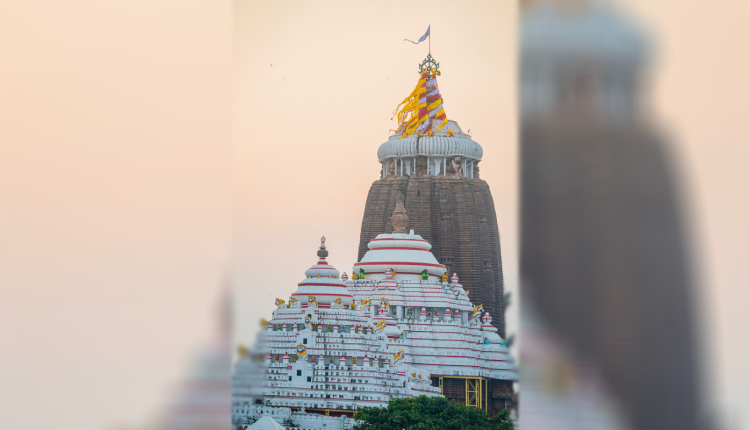
Bhubaneswar: Revenue records pertaining to 52.220 acres of land in Puri district have been corrected and restored in the name of Lord Jagannath following an order issued by the Odisha Board of Revenue, officials said on Friday.
The land, originally recorded in the name of Shree Jagannath Mahaprabhu in the 1927 settlement records, was subsequently entered in the name of an individual associated with Dakhin Parswa Mutt in the 1977 settlement records.
The correction was carried out by the Puri Tahasildar in compliance with an order passed by Satyabrata Sahu, Member of the Board of Revenue, Odisha, in a revision petition filed by the Shree Jagannath Temple Administration.
The order was passed in S.R.P. Case No. 103/2023 following a detailed examination of historical and current settlement records, revenue documents, field inquiry reports and legal submissions made by both parties. The Board allowed the revision petition and set aside the disputed entries in the 1977 settlement records to the extent of the land in question.
The land, measuring 52.220 acres and comprising 42 plots, is situated in Damodarpursasana Mouza under Puri Tahasil. The dispute arose from discrepancies between the 1927 and 1977 settlement records concerning the ownership and tenure status of the property.
According to the 1927 settlement records, Shree Jagannath Mahaprabhu, Bije-Puri, was recorded as the superior landlord, while an individual associated with Dakhin Parswa Mutt was mentioned as a tenure-holder.
The old Khata No. 429 comprised 11 plots. However, in the 1977 settlement records, 42 plots measuring a total of 52.220 acres were recorded under Khata No. 419 in the name of an individual. The Temple Administration challenged the legal basis of this alteration, arguing that the subsequent entries did not adequately reflect the rights recognised in the original settlement records.
During the proceedings, the Board examined the old and current settlement records, the correlation between Khatas and plots, remarks columns, the Jamabandi Register or Continuous Khatiyan, and other relevant revenue documents.
The remarks column of the 1977 records, which stated that the land was in the personal possession of the landlord before the abolition of the estate, was also examined. The Board considered the non-production of the Jamabandi Register or Continuous Khatiyan and the legal principle that a mere reference to possession does not, by itself, establish ownership or legally recognised occupancy rights.
A field inquiry report submitted by the Puri Tahasildar also formed part of the proceedings. According to the Revenue Inspector’s report, the 42 plots, covering an area of 52.220 acres, were lying vacant at the time of inspection.
Both parties were given opportunities to present their arguments and supporting documents. The matter was listed for hearing on more than 11 occasions, during which the opposite party was also provided repeated opportunities to raise objections and submit its claims and legal arguments.
The opposite party raised objections concerning the maintainability of the revision petition, the non-impleadment of necessary parties and issues relating to occupancy rights. The Board examined these objections separately before deciding the matter.
Advocate Ambika Mishra represented the Shree Jagannath Temple Administration and presented arguments concerning the discrepancies between the old and current settlement records, the superior landlordship rights of Lord Jagannath, the legal status of intermediary tenure-holders and the protection of Debottar properties. He relied on historical revenue documents and relevant statutory provisions to substantiate the Temple Administration’s case.
Siddhartha Shankar Das represented the State Government and presented arguments on its behalf, supporting the legal position of the concerned revenue authorities.
The Board also examined the provisions of the Odisha Survey and Settlement Act, 1958, including Section 13(3), concerning the presumption of correctness of finally published Records of Rights, and Section 15(b), relating to its revisional powers.
The relevance of Section 69 of the Odisha Hindu Religious Endowments Act, 1951, and Section 2(1) of the Shree Jagannath Temple Act, 1955, was also considered.
While deciding the matter, the Board examined judicial precedents, including the Odisha High Court judgments in Bikala Barik vs. Settlement and Consolidation Commissioner and Durgacharan Roula vs. Bhagirathi Roula. It also considered Kumari Kalyani Gajapati vs. Sarbajnya Jagannath in connection with the issue of notice under Section 69.
The principles laid down by the Supreme Court in its 2016 judgment in Shree Jagannath Temple Managing Committee vs. Sidh Math, concerning the legal status of Debottar properties and previously established rights, were also taken into consideration.
After examining the statutory provisions, judicial precedents, revenue documents, field inquiry report and submissions made by both parties, the Board of Revenue allowed the revision petition and directed the correction of the disputed entries in favour of Shree Jagannath Mahaprabhu, Bije-Puri, through the Shree Jagannath Temple Managing Committee.
The Puri Tahasildar has subsequently completed the necessary corrections in the revenue records pertaining to the 52.220 acres of land in compliance with the Board’s order.
Officials of the Shree Jagannath Temple Administration and the concerned revenue authorities, including the Puri Tahasildar, Settlement Officer, Cuttack, and Additional Sub-Collector, Puri, played roles in the proceedings.
The restoration has been welcomed by devotees and members of the public, who have viewed the decision as an important step towards protecting the properties of Lord Jagannath.
The Temple Administration has been examining historical and current settlement records relating to the deity’s properties in different parts of Odisha and pursuing legal remedies wherever discrepancies are found.
The decision is expected to strengthen efforts to safeguard the deity’s properties and ensure that revenue records accurately reflect their legal status. The protection of Lord Jagannath’s properties is also regarded as an important responsibility in preserving the religious, cultural and historical heritage of Odisha.