





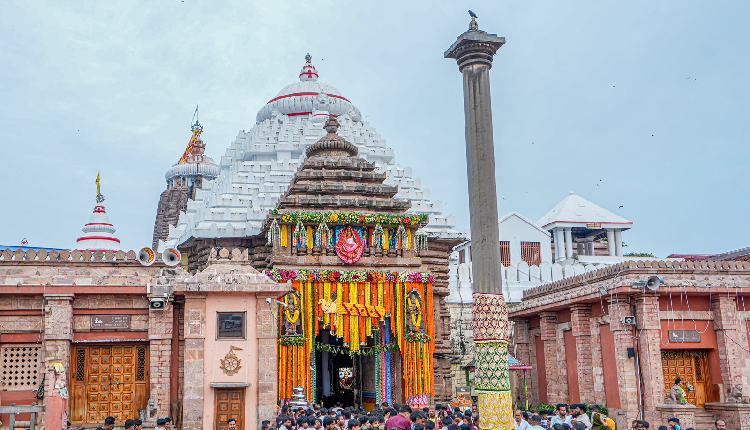
Bhubaneswar: In the interest of protecting the land of Lord Jagannath and legally recognising its historical ownership, Revenue Divisional Commissioner (RDC) Satyabrat Sahu has given an important verdict.
The Puri Sadar Tehsil considered two cases filed by the Sri Jagannath Temple administration regarding the ownership of land in Samangara area and other related accounts, and has directed the Puri Tehsildar to correct the title deeds of land above 81 acres in the name of Sri Jagannath Mahaprabhu, Puri through Sri Jagannath Temple Management Committee, Puri.
The disputed land of Samangara Mauja is located in a very valuable area near the Puri-Konark Marine Drive. The market value of the land is also very high as the importance of the area is increasing day by day in terms of tourism, connectivity and infrastructure.
The 81-acre land is located in the Puri Municipal Corporation area, near the Shri Jagannath Medical College. At an estimated market price of Rs 3,000 per sq ft, the total value of the 81-acre land is around Rs 1,060 crore.At the heart of the case is the land of Mahaprabhu’s historic ‘Sateish Hazari Mahal’ and the traditional ‘Kala Bethia Seva’ associated with it.
According to the temple administration, these lands in Samangara Mauja were originally the property of Mahaprabhu. Some servants were given the right to occupy the land in return for performing Kala Bethia Seva during the Rath Yatra. That is, their right over the land was intrinsically linked to the service. They were not given absolute ownership through this.
In support of this historical claim, the temple administration presented the duly certified deed of the temple. Since it contains a mention of Kala Bethiyya Seva, this document was of special importance in determining the original nature of the land and its historical rights.
However, during the previous settlement of 1927, these lands were recorded in the existing type. Later, on the basis of the auction sale of 1939 and the unregistered lease document of 1942, the opposing parties claimed their ownership over the said land and tried to establish rights in their favour. In the subsequent settlement, a record was also prepared in their name.
Challenging this record, the temple administration argued that if the original service holders did not have complete transferable ownership, then they could not give absolute ownership of the Mahaprabhu land to anyone else through auction, sale or lease. While considering this legal question, the RDC carefully considered the provisions of the Sri Jagannath Temple Act, 1955, relating to the special statutory status and protection of temple property.
As per Section 5 of the said Act, the management and administration of the temple is vested in the Management Committee of the temple. The RDC held that the statutory protection provided under this special Act cannot be defeated through proceedings under the general Revenue Act.
In the case, a field investigation report was sought from the Puri Tehsildar to ascertain the current physical condition of the lands. The report, submitted on the basis of the investigation, contained information regarding the condition of a total of 48 plots. The investigation revealed that many of the said plots were illegally occupied by various persons without any legal right or valid permission.
However, the RDC clarified that no legal ownership or title is created in favour of the person concerned by such unauthorised occupation or construction. Physical possession and legal ownership are two different things. The original ownership right does not change even if the land is encroached upon for a long time or a permanent construction is made thereon. Similarly, the presence of a name in the revenue records for a long time does not in itself create ownership.
Therefore, the RDC opined that the actual ownership of the land should be determined on the basis of available historical documents, evidence of original ownership and statutory provisions and the unauthorised encroachment should be resolved according to law.
After a thorough examination of the arguments of all the parties, the statutory charter of the temple, historical service provisions, old auction and transfer documents, the affidavit of the opposite party and the field investigation report of the Puri Tehsildar, the RDC has clarified an important legal distinction.
The RDC has come to the conclusion that there is no sufficient legal basis to deny the original ownership of Mahaprabhu Jagannath on the basis of subsequent documents and continuous revenue records, while the full transferable ownership of the original service holder has not been proven.