



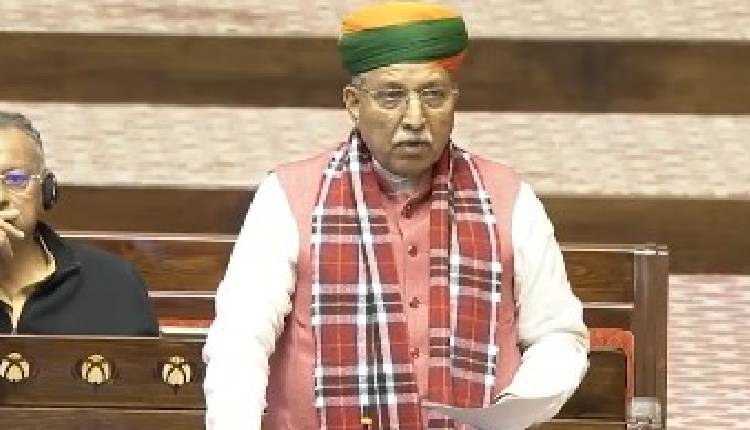
New Delhi: Minister of State (MoS) for Law and Justice, Arjun Ram Meghwal, said on Friday that as many as 116 women judges are currently serving in the Higher Judiciary which has a working strength of 814, with Punjab and Haryana High Court having the maximum number of 18.
Replying to a query in the Lok Sabha, MoS Meghwal shared data on the working strength and number of women judges in the Supreme Court and High Courts showing that at present, of the 33 Supreme Court judges, only one is a woman.
He said that since 2014, 170 women judges have been appointed in the High Courts, including 96 in the last five years and six in the Supreme Court.
The data showed that Allahabad High Court which has the largest working strength of 110 judges has seven women judges.
It showed that the Bombay High Court has the second highest number of work women judges at 12, followed by Delhi and Madras High Courts with 10 each.
The High Courts of three states of Uttarakhand, Tripura and Manipur have no representation of women in their benches.
The MoS said the appointment of judges to the Supreme Court and High Courts is made under Articles 124, 217 and 224 of the Constitution of India, which do not provide for reservation for any caste or class of persons.
MoS Meghwal said that only those persons who are recommended by the Supreme Court Collegium, are appointed as Judges of the Supreme Court and High Courts.
“As per the Memorandum of Procedure, the responsibility for initiation of proposals for appointment of Judges in the Supreme Court vests with the Chief Justice of India, while the responsibility for initiation of proposals for appointment of Judges in the High Courts vests with the Chief Justice of the concerned High Court,” he added.
However, the Union government is committed to enhancing social diversity in judiciary and has been requesting the Chief Justices of High Courts that while sending proposals for appointment of Judges, due consideration be given to suitable candidates belonging to Scheduled Castes, Scheduled Tribes, Other Backward Classes, minorities and women to ensure social diversity in the appointment of Judges in High Courts.
(IANS)