


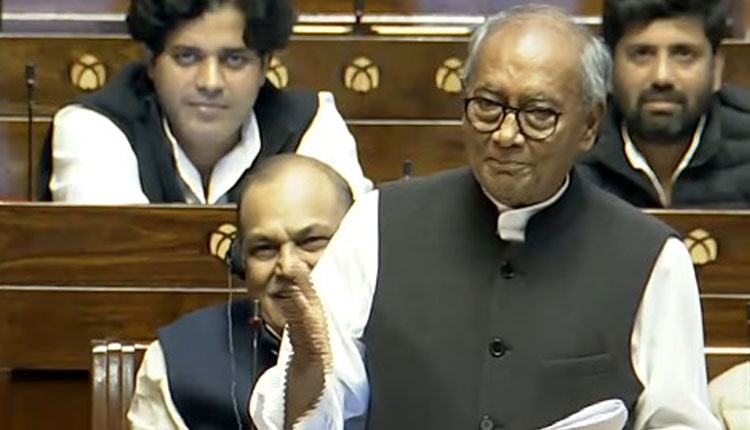
New Delhi: The Rajya Sabha witnessed heated exchanges during the ongoing discussion on electoral reforms, as senior Congress member Digvijaya Singh launched a sharp attack on the government, alleging systemic irregularities in the electoral process and questioning Home Minister Amit Shah’s association with the Rashtriya Swayamsevak Sangh (RSS).
In a pointed personal attack that drew strong protests from the Treasury Benches, Singh claimed Amit Shah “was never in the RSS”, challenging him to prove otherwise.
Digvijaya Singh said that PM Modi, from the ramparts of the Red Fort, had called the RSS the world’s biggest NGO. He added that in the Rajya Sabha, Home Minister Amit Shah had said both the PM and he himself follow the RSS ideology.
But Singh questioned this. He pointed out that while PM Modi proudly talks about his own RSS background, Amit Shah has never actually been part of the RSS.
Singh quoted a statement from Shah in the Rajya Sabha, where Shah had said about PM Modi: “Garv se kehte hain Modi ji Sangh ke pracharak rahe hain (We proudly say that Modi ji has been an RSS pracharak)”. Singh also noted that Shah had claimed he himself started attending RSS shakhas at the age of 10. However, Singh said his own friends in the RSS told him, “Shahji was never associated with the RSS.”
This remark led to loud protests from ruling party MPs. Union Law Minister Arjun Ram Meghwal stood up and accused Singh of twisting and misinterpreting Amit Shah’s earlier statements.
Singh claimed that Home Minister Amit Shah had failed to address key concerns raised by Congress leader Rahul Gandhi, including demands for machine-readable digital voter lists, transparent audits of Electronic Voting Machines (EVMs), reforms in the appointment process for the Chief Election Commissioner, and explanations for the deletion of CCTV footage from polling stations.
Countering Shah’s earlier statement in Parliament that no political party had submitted proposals or suggestions on electoral reforms from 2014 to 2025, Singh said he had personally written a letter to the Chief Election Commissioner, which went unacknowledged.
“Either the Election Commission is misleading the Home Minister, or the Home Minister is misleading the House,” he alleged, demanding accountability and actions.
The Congress leader highlighted alleged discrepancies in voter lists, noting instances where one person’s name appeared in 25-50 places, and claimed that deduplication software was halted once irregularities came to light.
He questioned the need for the Special Intensive Revision (SIR) of electoral rolls alongside regular summary revisions, alleging no formal order existed on file for SIR to be conducted, as revealed through RTI queries.
Singh also raised concerns over differing voter lists provided to candidates and presiding officers, ‘selective enforcement’ of the model code of conduct (citing no action against appeals invoking religious sentiments), and the influence of money power in elections.
He criticised the high expenditure ceiling in the Lok Sabha polls and expressed personal support for returning to ballot papers, arguing that full verification of Voter Verifiable Paper Audit Trail (VVPTR) slips would ensure voter satisfaction without significant delays.
On the proposed ‘One Nation, One Election’ framework, Singh called it an “insult” to federalism and a step towards “fascist dictatorship”, warning that basing delimitation solely on demographic ratios would disrupt the North-South balance in representation.
Singh equated high voter turnouts (citing 94 per cent in some cases, unseen in his 50 years in politics) to practices in authoritarian regimes, referencing historical figures like Hitler and Mussolini, as well as contemporary examples.
The debate on electoral reforms, part of the Winter Session’s focus on strengthening democratic processes amid opposition allegations of voter list manipulations, saw sharp divisions.
Treasury Bench members accused the opposition of undermining institutions, while Congress leaders demanded greater transparency from the Election Commission. The session continues with more members expected to participate in the electoral reforms discussion.
(IANS)