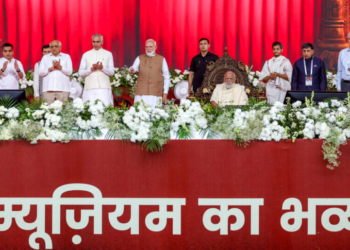



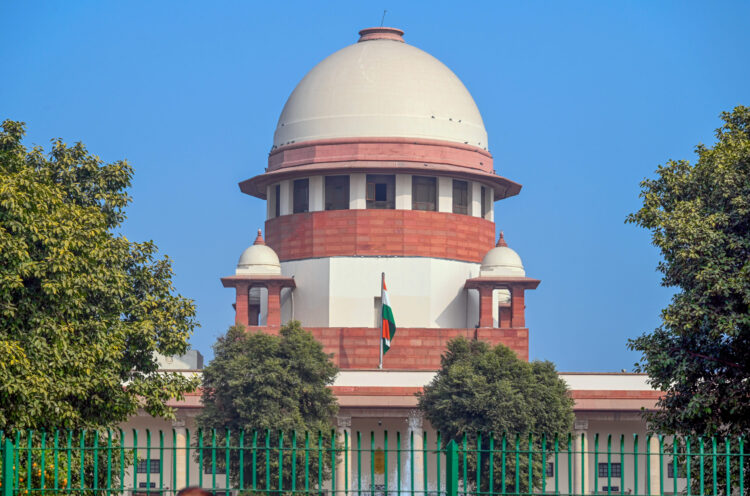
New Delhi: The Supreme Court is slated to hear, on Wednesday, a plea filed by the Muslim side challenging the Madhya Pradesh High Court’s order in the long-standing Bhojshala Temple-Kamal Maula Mosque dispute in Dhar district.
As per the causelist published on the official website of the apex court, a Bench of Chief Justice of India (CJI) Surya Kant and Justices Joymalya Bagchi and Vipul M. Pancholi will take up the Special Leave Petition (SLP) filed by the Maulana Kamaluddin Welfare Society on April 1.
The plea assails the March 16 order passed by the Indore Bench of the Madhya Pradesh High Court, which had decided to undertake a personal inspection of the disputed Bhojshala complex before the next date of hearing and fixed April 2 for commencement of regular hearings in the matter.
The Muslim side, in its SLP before the top court, has contended that it was not granted an adequate opportunity to file objections to the report submitted by the Archaeological Survey of India (ASI).
Earlier, on March 16, a Division Bench of Justices Vijay Kumar Shukla and Alok Awasthi of the Madhya Pradesh High Court had, after hearing extensive arguments, observed that in view of the multiple disputes surrounding the Bhojshala Temple–Kamal Maula Mosque complex, it would personally visit the site prior to the next hearing.
The Justice Shukla-led Bench had clarified that no parties would be allowed to remain present during the inspection.
The MP High Court had also directed all stakeholders to submit their objections, suggestions, and responses to the ASI’s survey report before April 2, when the matter is scheduled for regular hearing.
The ASI, which conducted a detailed scientific survey of the protected monument, had indicated that the existing structure bears features of earlier temple architecture, a claim disputed by the Muslim side.
The dispute centres on competing claims over the historical character of the Bhojshala complex, with the Hindu side asserting that it was originally a temple, while the Muslim side has challenged both the ASI findings and the methodology adopted during the survey.
Notably, in an earlier order passed on January 22, the Supreme Court had permitted both communities to carry out their respective religious practices at the site. While allowing Basant Panchami worship without time restrictions, the CJI Surya Kant-led Bench had directed that Friday namaz be offered between 1 p.m. and 3 p.m. at a separately demarcated area within the premises.
The apex court had stressed the need for maintaining communal harmony and urged both sides to cooperate with authorities to ensure law and order, laying down a balanced framework for the exercise of religious rights at the disputed site.
(IANS)