


New Delhi: Prime Minister Narendra Modi landed in Israel for a two-day state visit, where he will hold wide-ranging discussions with Israeli counterpart Benjamin Netanyahu, and also address the Israeli Parliament, Knesset – the first by any Indian Prime Minister.
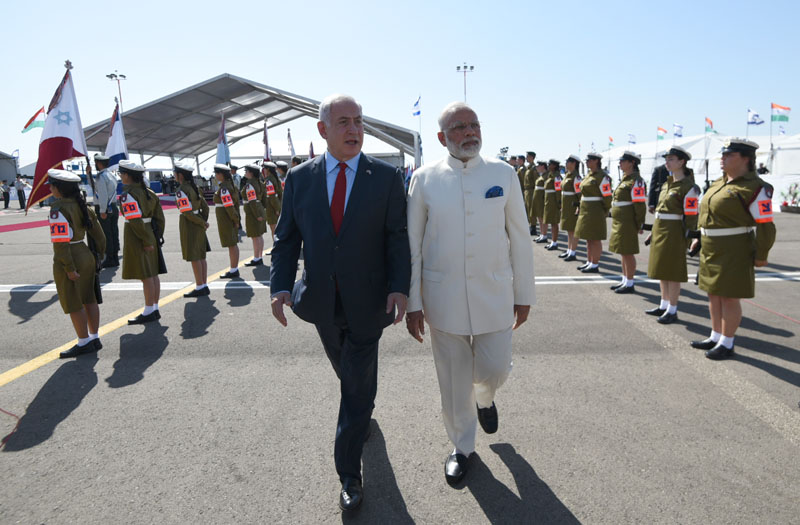
Israeli PM Netanyahu received PM Modi at the Tel Aviv airport, as he did during the last visit in July 2017, and the two leaders over the next two days are expected to engage at various platforms, including Prime Minister Narendra Modi’s address to the Knesset, a private dinner, a visit to the Holocaust museum, an address to the Indian diaspora and more.
The visit has been dubbed historic. But, so was the 2017 visit, as PM Modi was accompanied by Israeli counterpart throughout the tour.
Ahead of PM Modi’s second visit to Israel, first in 2017 and now in 2026, here is a look at his previous engagements with Israel, which initially began as Gujarat Chief Minister.
It was in May 2006 that the then Gujarat CM Narendra Modi travelled to Israel for the first time, leading an Indian delegation to Agritech 2006, Israel’s premier international agricultural technology exhibition. The delegation included other chief ministers and senior agricultural officials, who studied Israeli innovations in farming and water management.
According to Modi Archive, a noted social media handle on X, the then CM Narendra Modi presented Gujarat’s agricultural vision at the Israel-India Business Forum under the slogan “Per Drop More Crop”, and also drew “maximum applause and appreciation” from the audience.
Incidentally, the “Per Drop More Crop” later went on to become the motto of the Pradhan Mantri Krishi Sinchai Yojana, India’s national micro-irrigation scheme.
Eleven years later, in 2017, Prime Minister Narendra Modi visited Israel, marking the first bilateral visit by an Indian Prime Minister.
“The agricultural theme that had run through 2006 ran through this one too,” informs the Modi Archive.
It says that the first stop of PM Modi and Netanyahu during this trip was a flower farm, where Israel’s leading flower genetics company had developed a new white chrysanthemum for the occasion and named it “MODI.”
“The 3-Year Work Programme in Agriculture signed during the visit was the formal institutionalisation of what CM Modi had personally initiated at Agritech-2006,” it further states.
It adds that the Netafim relationship he had worked on as Chief Minister became a government-to-government framework as Prime Minister.
Later during his address to the Indian diaspora in Tel Aviv, PM Modi emphasised, “Israel’s cooperation in the agriculture sector can help India in the second green revolution.”
The visit also produced one of its defining images: PM Modi and PM Netanyahu at a demonstration of Israel’s mobile water desalination technology.
The Modi Archive X handle further says that both countries have been working on the same problems from different angles. India had the scale, the farmland, and the need, while Israel had turned constraint into technique, developing drip irrigation, wastewater recycling, and desalination into systems that could be exported, replicated, and built upon.
“CM Modi had recognised in 2006 that these were exactly the techniques Gujarat and India needed, and had come back as Prime Minister to make it a national commitment. In 2026, PM Modi returns to Israel, putting the spotlight back, keeping agriculture, water management, and food security at the core of expanding ties,” it further states.
(IANS)