


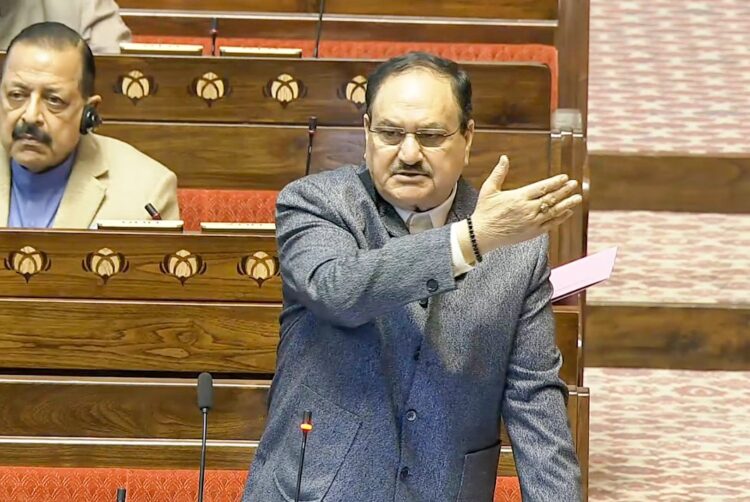
New Delhi: Leader of the House in Rajya Sabha, J.P. Nadda, on Thursday revisited the Constituent Assembly’s deliberations on the national anthem, drawing a sharp distinction between the treatment accorded to Jana Gana Mana and Vande Mataram.
Speaking during the ongoing debate on Vande Mataram, Nadda said that while the Assembly had set aside time to discuss and finalise Jana Gana Mana as the anthem, requests to extend similar consideration to Vande Mataram were not accepted.
Nadda argued that this reflected the reservations of the country’s first Prime Minister, Jawaharlal Nehru, who, according to archival records, did not regard Vande Mataram as a feasible choice for the anthem.
Quoting from Nehru’s letters, Nadda said the Congress leader believed the song was not suitable for orchestral arrangement, particularly in foreign settings where India’s anthem would be performed.
Reading from one such letter, Nadda underlined Nehru’s view that the composition, though emotionally stirring, carried linguistic and stylistic complexities that made it difficult to adapt for formal occasions abroad.
“Nehru himself wrote that Vande Mataram was not suitable for orchestral arrangement, especially in foreign countries,” Nadda told the House, adding that this was a decisive factor in the Constituent Assembly’s choice.
In a charged exchange in the Rajya Sabha, Leader of Opposition Mallikarjun Kharge asked whether the debate was truly about Vande Mataram or merely about Jawaharlal Nehru.
Responding sharply, Leader of House Nadda accused the Congress of having compromised “since the beginning” on the culture, ethos and thought process of Bharat. He asserted that the invocation of Maa Bharti or Bharat Mata was not a partisan slogan belonging to the Jan Sangh, RSS or BJP, but a civilisational expression rooted in thousands of years of Indian history.
Nadda stressed that the phrase embodies the collective spirit of Indian culture, transcending political boundaries and reflecting the nation’s deep cultural heritage.
His remarks sought to frame Bharat Mata as a timeless symbol of identity and reverence, contrasting it with what he described as Congress’ reluctance to embrace cultural traditions. The exchange underscored the ideological divide over national symbols and their interpretation in modern politics.
By invoking Nehru’s words, Nadda sought to highlight what he described as a deliberate sidelining of Vande Mataram despite its role in inspiring generations during the freedom struggle.
The remarks sparked animated exchanges in the House, with members from the Treasury benches insisting that the song deserved greater recognition, while opposition members accused the government of selectively quoting history to score political points.
(IANS)