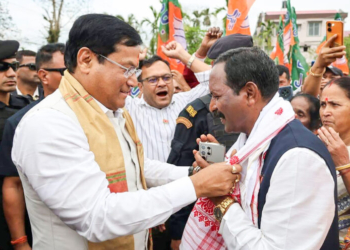





New Delhi: Prime Minister Narendra Modi inaugurated the Grand International Exposition of Sacred Piprahwa Relics associated with Bhagwan Buddha at the Rai Pithora Cultural Complex in Delhi on Saturday.
PM Modi said that the wisdom of Lord Buddha and the path shown by him are not confined to any era but for all humanity and are timeless.
Discovered in 1898, the Piprahwa relics occupy a pivotal place in the archaeological study of early Buddhism. They are among the earliest and most historically significant relic deposits directly associated with Lord Buddha.
Archaeological evidence links the Piprahwa site to ancient Kapilavastu, widely believed to be the place where Gautam Buddha spent his early life before renunciation.
Addressing the gathering, PM Modi said, “The heritage of India has returned to the country after a wait of 125 years. From today, Indians will be able to have darshan and seek blessings of these pure relics of Lord Buddha.”
“The beginning of 2026 itself is filled with this joyous festival, which is very inspiring. And it is also my fortune that my first public event of 2026 is starting at the feet of Lord Buddha. I pray that with the blessings of Lord Buddha, 2026 brings peace and prosperity across the world,” he said.
The Prime Minister said that the venue of the exhibition — Qila Rai Pithora — is “special” and serves as a “testament to India’s glorious history”.
“Almost a thousand years ago, rulers of that era established a fortified and well-protected city within the walls of this historic fort. Today, in the same historic precinct, we are connecting with a spiritual and sacred chapter of our history,” he said.
“I examined this historical exhibition in detail. We are all blessed to have the sacred relics of Lord Buddha among us. Their journey from India and their return to India, both these phases in themselves carry a profound lesson — slavery is not only political and economic; it also erodes our heritage,” PM Modi added.
He said that the same happened with the sacred relics of Lord Buddha, when they were taken from India during the colonial rule and for nearly 125 years they remained abroad.
“For those who took them, they were mere lifeless antiques, and so they tried to auction these sacred relics in the international market. But for India, these sacred relics are a part of our soul, an integral aspect of our civilisation. Therefore, India resolved that we would not allow their public auction,” he added.
PM Modi further thanked the Godrej Group, stating, “With their cooperation, these sacred relics associated with Lord Buddha have now returned to his birthplace, his land of contemplation, his land of great enlightenment, and his land of Mahaparinirvana.”
“The wisdom of Lord Buddha and the path shown by him are not confined to any era but are for all humanity and timeless,” he said.
“We have repeatedly experienced this sentiment over the past few months. Over the last few months, wherever the sacred relics of Lord Buddha travelled, they sparked waves of faith and reverence,” PM Modi said, citing examples of Thailand, Mongolia, Russia and Vietnam.
“In Thailand, where such sacred relics were placed at various locations, more than 40 lakh devotees paid their respects in less than a month. In Vietnam, public devotion was so immense that the exhibition period had to be extended — nearly two crore people across the country paid homage to the Buddha relics. In Mongolia, thousands waited for hours outside the Gandan Monastery; many even sought to touch the Indian representatives simply because they came from the land of Buddha,” he added.
He mentioned that in Russia’s Kalmykia region, over 1.5 lakh devotees visited the sacred relics in just one week, which PM Modi said is more than the region’s total population.
“In various countries where these events were organised, from the common public to heads of governments, everyone was united in equal reverence. Lord Buddha belongs to all, and Lord Buddha unites everyone,” the Prime Minister added.
PM Modi said that he considers himself “very fortunate” and that Lord Buddha “holds a very deep place” in his life.
“I was born in a region that was a great centre of Buddhist learning. Sarnath, where Lord Buddha delivered his first sermon, is my constituency today. Even before I entered government responsibilities, I visited Buddhist pilgrimage sites as a pilgrim. As Prime Minister, I have been privileged to travel to Buddhist pilgrimage sites worldwide,” he said, giving examples of Maya Devi Temple in Lumbini, Nepal, and his visits to Japan, Mongolia and China.
The recent repatriation of the relics has been made possible through sustained government efforts, institutional collaboration, and innovative public–private partnerships.
Organised thematically, the exhibition features a reconstructed interpretive model inspired by the Sanchi stupa at its centre, bringing together authentic relics from national collections and the repatriated gems.
Other sections include Piprahwa Revisited; Vignettes of the Life of Buddha; Intangible in the Tangible: The Aesthetic Language of Buddhist Teachings; Expansion of Buddhist Art and Ideals Beyond Borders; and Repatriation of Cultural Artefacts: The Continuing Endeavour.
To deepen public engagement and understanding, the exposition is supported by an extensive audio-visual experience, including immersive films, digital reconstructions, interpretive projections, and multimedia presentations.
(IANS)