


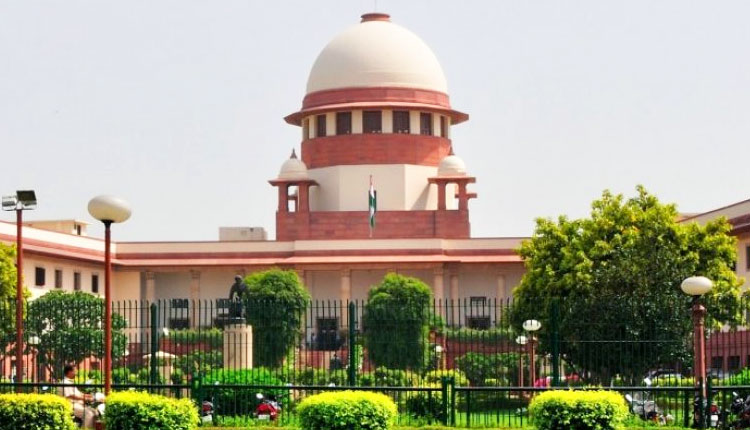
New Delhi: The Supreme Court on Wednesday expressed concern over the alarming rise in dog bite incidents across the country and the failure of municipal authorities and local bodies to effectively implement the Animal Birth Control (ABC) Rules.
A Bench of Justices Vikram Nath, Sandeep Mehta, and N.V. Anjaria, hearing the suo motu case on stray dog management in public spaces, observed that both children and adults were being bitten and that lives were being lost due to continued inaction.
“We are conscious that these things are happening. Children, adults are getting bit, people are dying,” the Justice Nath-led Bench remarked, adding that in the last 20 days alone, two judges had been involved in animal-related road accidents.
The apex court said the presence of stray animals on roads was not just a biting issue but also a major cause of accidents.
“While they are running on the road it is a problem. Roads where there are moving vehicles. It’s just not biting,” it observed.
Amicus curiae and senior advocate Gaurav Agarwal informed the Justice Nath-led Bench that pursuant to the top court’s earlier directions, the National Highways Authority of India (NHAI) had prepared a Standard Operating Procedure (SOP) and identified about 1,400 km of vulnerable highway stretches.
However, he pointed out that implementation would require coordinated action by state governments, including creation of shelters and manpower for ABC centres.
The amicus also informed the court that several major states, including Madhya Pradesh, Uttar Pradesh, Tamil Nadu, Karnataka and Punjab, were yet to file compliance affidavits.
The Justice Nath-led Bench warned that the Supreme Court would take a strict view of non-compliance.
“We will be harsh on states which have not responded,” it said.
Senior advocate Kapil Sibal, appearing for animal welfare groups, contending that population control through sterilisation and vaccination was the only sustainable solution, cautioning that indiscriminate removal of dogs from their territories could aggravate the problem.
Referring to the globally accepted CSVR (Capture, Sterilise, Vaccinate and Release) model, Sibal said unscientific relocation could lead to territorial vacuum, dog fights and increased spread of rabies.
When Sibal stated that people needed to “live with animals”, the top court responded sharply. “You are lucky. People are being bitten, children are being bitten,” the Justice Nath-led Bench said, stressing that institutional premises such as courts, schools and hospitals stood on a different footing and must remain free of stray animals.
The apex court questioned how dogs could be allowed in places meant for unhindered access by children, patients and persons with disabilities.
Solicitor General (SG) Tushar Mehta, appearing for the authorities, suggested that residents’ welfare associations of gated communities should be allowed to decide by voting whether stray animals may be permitted within their premises, adding that compassion for animals could not override the rights and safety of residents.
The hearing in the matter will continue on Thursday, with the Supreme Court likely to further examine the matter and the status of compliance by states and union territories(UTs).
(IANS)