



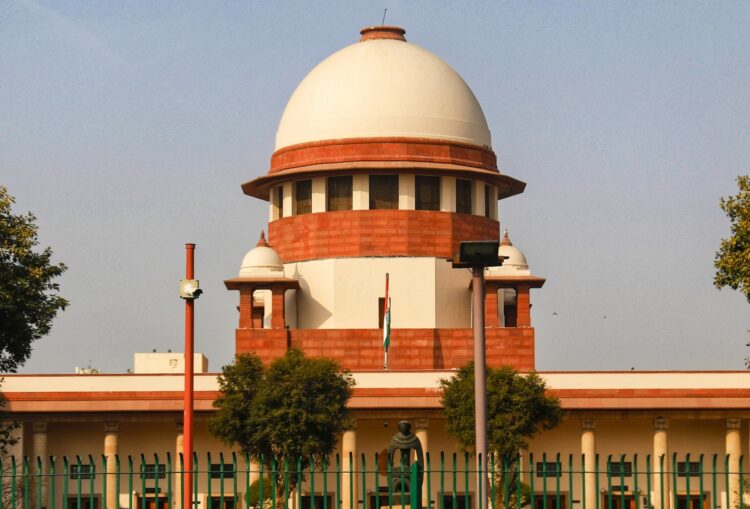
New Delhi: The Supreme Court on Thursday refused to entertain a plea seeking to restrain the conduct of the Maha Shivaratri puja at the Raghava Chaitanya Shivling, which is installed within the premises of the Laadle Mashaik Dargah in Karnataka’s Kalaburagi district.
A bench of Justices Dipankar Datta and S.C. Sharma expressed disinclination to examine the writ plea filed under Article 32, following which the dargah management sought to withdraw the petition.
The apex court then dismissed the matter as withdrawn.
Senior advocate Vibha Datta Makhija, appearing for the dargah management, contended that though the property had already been declared a waqf property by the Waqf Tribunal, third parties had been filing writ petitions before the Karnataka High Court seeking permission to conduct pujas on specific occasions.
She submitted that the Karnataka High Court had been passing interim orders from time to time allowing performance of rituals, including in connection with the upcoming Maha Shivaratri on February 15, and argued that such interim orders permitting rituals amounted to interference with the religious character of the property and were violative of the Places of Worship (Special Provisions) Act, 1991.
The dargah management’s plea sought directions to protect the waqf character of the dargah and to restrain the passing of any interim orders permitting entry, puja, inspection, survey, construction, installation, or alteration of the religious character of the premises.
Makhija also relied on a December 2024 order of the Supreme Court barring courts from entertaining new petitions questioning the religious character of places of worship.
She requested that the matter be tagged with pending cases relating to the Places of Worship Act.
However, the Justice Datta-led Bench declined the request and refused to entertain the writ petition. It observed that a petition filed directly before the apex court under Article 32 of the Constitution was not the appropriate remedy in the facts of the case.
“Unless it is a pan-India issue, this is no way of entertaining an Article 32 petition. Just because some orders are passed by the Karnataka High Court, we cannot directly intervene,” the apex court remarked.
When the matter had been mentioned a day earlier before Chief Justice of India (CJI) Surya Kant for urgent hearing, he had also expressed concern over petitions being filed directly before the apex court without first approaching the jurisdictional High Court.
“Why is everything coming under Article 32? The impression created is that pleas are being filed because the law is convenient, and the message going out is that the High Court is defunct,” the CJI had observed.
The shrine at the centre of the dispute is associated with 14th-century Sufi saint Hazrat Shaikh Alauddin Ansari, also known as Ladle Mashaik, and 15th-century Hindu saint Raghava Chaitanya.
According to sources, Chaitanya was the guru of Samarth Ramadas, who was revered by Maratha king Chhatrapati Shivaji. The premises house the samadhi of Chaitanya, on which a structure referred to as the Raghava Chaitanya Shivling has been erected.
Historically, both Muslims and Hindus have offered prayers at the site. However, tensions have flared intermittently in recent years over worship rights and the character of the premises. The dispute had resurfaced during Maha Shivaratri celebrations last year as well.
In February 2025, the Karnataka High Court permitted a limited number of Hindu devotees to perform puja at the Raghava Chaitanya Shivling under regulated conditions. The order allowed 15 persons from the Hindu community to conduct worship during specified hours and under tight administrative and security arrangements. Earlier, too, permissions had been granted for similar worship under controlled circumstances, with separate time slots allotted to members of both communities to avoid confrontation.
(IANS)