



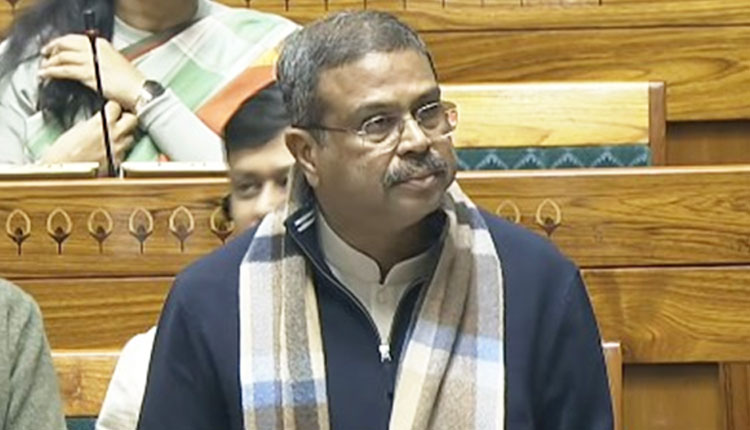
New Delhi: Union Education Minister Dharmendra Pradhan on Monday introduced the Viksit Bharat Sikhsha Adhishthan Bill 2525 in the Lok Sabha during the ongoing Winter Session of Parliament, setting the stage for a major overhaul of India’s higher education regulatory framework.
The Bill seeks to establish a Higher Education Board aimed at centralising regulation in the sector and restructuring the existing system by consolidating multiple regulatory councils under a single commission.
The introduction of the Bill, however, faced sharp resistance from the opposition.
Congress MP Manish Tewari opposed the move, arguing that the proposed legislation gives the Centre excessive authority in shaping education policy, thereby eroding the powers of state governments and higher education institutions.
“It also interferes in administrative matters of institutions, robbing them of their independence in day-to-day affairs and appointments,” Tewari said while objecting to the Bill’s introduction.
Several other opposition MPs also raised similar concerns and demanded that the legislation be withdrawn from the Lok Sabha.
Following the objections, the Bill was referred to a Joint Parliamentary Committee (JPC) for detailed scrutiny.
The proposed legislation lays out an ambitious plan to create a unified framework for regulation, accreditation and standard-setting in higher education.
It emphasises outcome-based education and the integration of ‘Bharatiya’ knowledge systems, aligning with the government’s broader vision of an ‘Atmanirbhar Bharat’.
Through the Bill, the Centre aims to establish a commission that would facilitate universities and other higher educational institutions “to become independent self-governing institutions and to promote excellence through a robust and transparent system of accreditation and autonomy.”
Under the proposed structure, the Commission will function through three distinct wings: a Regulatory Council, an Accreditation Council and a Standards Council. The 12-member commission will include the presidents of these three councils, the Union higher education secretary, two eminent and distinguished academicians not below the rank of professor from state higher educational institutions, five eminent experts, and a member secretary.
Appointments to the Commission will be made exclusively by the Centre through a three-member search panel. The Bill also provides legal protection to office-bearers and employees of the Commission and its councils.
The legislation proposes stringent penalties for non-compliance. Educational institutions found violating provisions of the new law and failing to rectify shortcomings may face fines ranging from a minimum of Rs 10 lakh to Rs 30 lakh. In cases of repeated offences, higher educational institutions could be fined at least Rs 75 lakh or face suspension.
According to the Bill, the Commission will offer “high-level strategic direction for comprehensive and holistic growth of higher education and research in a competitive global environment.”
It will also work to “develop a roadmap for transforming higher educational institutions into large multi-disciplinary education and research institutions” and to “develop a roadmap for promoting India as an education destination.”
(IANS)