


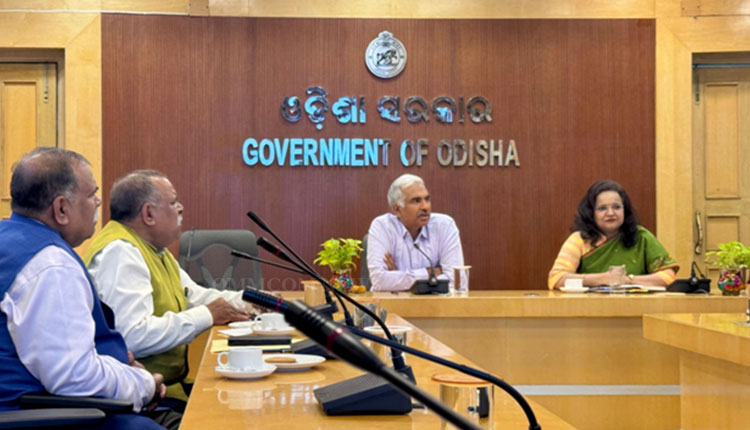
Bhubaneswar: Chief Secretary Manoj Ahuja recently chaired a high-level meeting at Lok Seva Bhawan with distinguished Odia scholars and twin brothers, Prof. Kishor Basa and Er. Ashok Basa.
The discussion was convened soon after their meeting with President Droupadi Murmu at Rashtrapati Bhawan on November 18, where they had submitted detailed proposals for Odisha’s cultural, educational and water governance reforms.
The meeting was attended by Development Commissioner-cum-Additional Chief Secretary Anu Garg and senior secretaries from the Panchayati Raj & Drinking Water, Tourism, ST & SC Development, and Odia Language & Culture departments, along with other senior officials of the State Government.
During the interaction, Prof. Kishor Basa presented the proposals he had earlier submitted to the President of India, focusing on the socio-cultural and educational advancement of Mayurbhanj district. He emphasised the need for establishing a National Institute of Tribal Development at Rairangpur under the Ministry of Tribal Affairs, highlighting its strategic location near major tribal regions of Odisha, Jharkhand and West Bengal. He also stressed the importance of creating a National Centre for Jhumar at Baripada, noting that Jhumar is an important form of intangible cultural heritage practised across several eastern and northeastern states. Additionally, he underscored the significance of bringing the Archaeological Museum at Khiching under the Archaeological Survey of India to ensure better preservation and national-level promotion. According to him, these initiatives would significantly contribute to tribal empowerment, heritage conservation and the balanced development of the region.
Er. Ashok Basa followed with a detailed presentation on the urgent need to reform water governance in Odisha, drawing attention to national projections that warn of an acute water crisis by 2050 and its potential economic repercussions. He pointed out that Odisha remains highly vulnerable due to groundwater depletion, inefficient water use in agriculture and the increasing impact of climate variability. He reiterated the need for creating the Odisha State Water Management Authority as a nodal body to streamline water demand and supply across various departments. He also recommended preparing district-wise balance sheets that would scientifically map water demand and the availability of resources. He noted that timely reforms could position Odisha as a pilot state for national water governance efforts and help realise the long-term goal of transforming Odisha into a “Water Surplus State by 2036.”
The Chief Secretary appreciated the depth of research, clarity and commitment reflected in the proposals. The State Government acknowledged the suggestions as valuable contributions towards cultural preservation, tourism development, tribal upliftment and the strengthening of water security. He directed the concerned departments to examine the proposals in detail and initiate necessary follow-up action. Expressing gratitude on behalf of the Government of Odisha, he said the expertise and experience of Prof. Kishor Basa and Er. Ashok Basa would be meaningfully utilised in the State’s developmental initiatives aimed at achieving the vision of a Viksit Odisha and Viksit Bharat.