


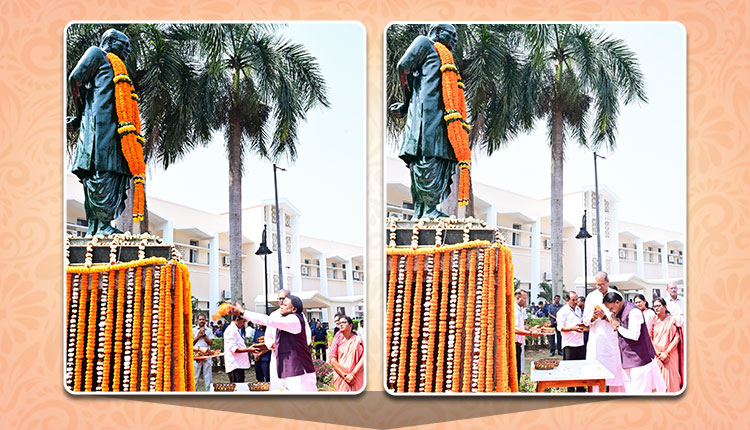
Bhubaneswar: Odisha observed the birth anniversary of its revered leader, Biju Patnaik, with great fervour and respect. On this occasion, Chief Minister Mohan Charan Majhi, Speaker of Odisha Legislative Assembly Surama Padhy, Deputy Chief Ministers Kanak Vardhan Singh Deo and Pravati Parida, and other MLAs paid floral tributes to the late leader on the Odisha Legislative Assembly premises.
In his tribute, Chief Minister Majhi recalled Biju Patnaik’s remarkable life, marked by struggle and service to the people. “Biju Babu’s life was a testament to his unwavering commitment to the state and its people. He lived with dignity and pride, always prioritizing the welfare and development of Odisha,” said Majhi.
Majhi further stated that despite the passage of time, Biju Patnaik’s dreams and vision for the state remain relevant today.
“Many of his dreams are yet to be fulfilled, but our government is determined to turn them into reality,” he said, reiterating the state’s commitment to building a prosperous and developed Odisha.
Biju Patnaik, a stalwart leader and a true son of Odisha, left an indelible mark on the state’s politics and development.
Born on March 5, 1916, in Cuttack, Biju Patnaik’s life was a testament to his unwavering courage and unrelenting passion for service. His ancestors hailed from Bellaguntha in Ganjam District, and his parents, Laxminarayan Patnaik and Ashalata Devi, nurtured a young Biju who would grow to become the ‘Iron Man of Odisha’.
A trained pilot with a penchant for adventure, Biju Patnaik’s fascination with aviation led him to drop out of Ravenshaw College. His bravery during World War II earned him recognition from the British rulers, who honored him for rescuing British families trapped by the Japanese. This daring spirit would become a hallmark of his life, earning him the title ‘Tall Leader’.
Biju Patnaik served as the Chief Minister of Odisha twice, first from 1961 to 1963 and later from 1990 to 1995. During his tenure, he was widely credited for initiating major industrial and infrastructure projects that contributed significantly to the state’s economic development.
Notably, he remains the only Indian leader whose mortal remains were draped in the national flags of India, Russia and Indonesia after his passing, in recognition of his contributions and global impact.