



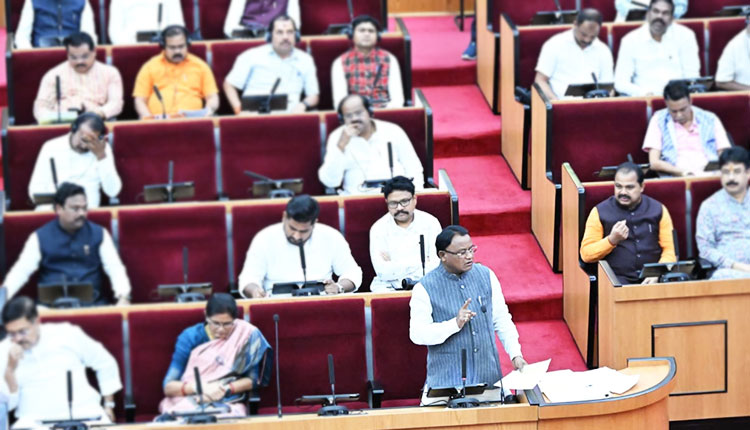
Bhubaneswar: Chief Minister Mohan Charan Majhi on Tuesday tabled five important reports of the Comptroller and Auditor General (C&AG) in the Odisha Legislative Assembly, bringing to light significant concerns relating to governance, welfare schemes, infrastructure development and fiscal management in the State.
The reports, which include compliance and performance audits, State Finances, and sector-specific assessments such as tribal development, MGNREGS, POSHAN and Mid-Day Meal schemes, present a mixed picture of Odisha’s administrative performance.
During a subsequent press briefing, Accountant General Atul Prakash outlined the key findings, indicating that while the State has maintained macro-fiscal stability, several systemic and implementation-related deficiencies persist.
The State Finances Audit Report noted that Odisha’s economy recorded a growth of 11.40 per cent during 2024–25 and maintained a revenue surplus, with the fiscal deficit remaining within prescribed limits. However, the audit flagged concerns such as weak revenue buoyancy, non-realisation of dividends amounting to ₹5,146 crore from State Public Sector Undertakings, misclassification of ₹721 crore as capital expenditure and large-scale under-utilisation of budgetary provisions to the tune of ₹56,157 crore. The report also highlighted pending utilisation certificates worth ₹16,585 crore and a significant future repayment burden estimated at ₹76,642 crore over the next seven years.
Serious shortcomings were observed in the implementation of nutrition-related schemes under POSHAN and ICDS, where despite availability of funds, about 1.98 lakh beneficiaries were deprived of supplementary nutrition. The audit pointed to irregularities in procurement and distribution of food grains, resulting in losses exceeding ₹20 crore, alongside excess payments to self-help groups and inadequate infrastructure in Anganwadi Centres. A considerable number of children were found to be moderately malnourished, raising concerns over the effectiveness of these flagship schemes.
The audit of Public Sector Undertakings revealed delays in submission of financial accounts by several government companies, which affected transparency and accountability.Poor planning and idle mining leases led to significant financial losses and avoidable expenditure, while irregular and excess mining operations resulted in penalties and revenue loss.
Similarly, the Mid-Day Meal programme suffered from irregularities, including non-serving of meals on several occasions, diversion and parking of funds exceeding ₹92 crore, and inadequate health check-ups, which covered less than half of the students. Instances of possible misappropriation were also flagged in schools lacking basic infrastructure.
The performance audit on tribal development revealed that more than half of the Particularly Vulnerable Tribal Group population remained excluded from welfare schemes due to poor planning and implementation. Financial irregularities, including loans extended to ineligible beneficiaries, and the failure of several livelihood and infrastructure projects were also highlighted. In the case of MGNREGS, the audit found that a significant number of rural households were denied employment despite demand, while only a small percentage could avail the mandated 100 days of work. Delays in wage payments, non-payment of unemployment allowance and a large number of incomplete works despite substantial expenditure further underscored deficiencies in execution and monitoring.
The compliance audit report pointed to major delays in infrastructure projects, especially road construction, with some projects delayed by several years. It also highlighted avoidable expenditure due to poor planning, non-imposition of penalties on contractors and deficiencies in public service delivery, including overcrowding in prisons and weaknesses in digital financial management systems.
Overall, the C&AG reports underline that while Odisha has demonstrated fiscal discipline at the macro level, gaps in planning, execution, monitoring and accountability across sectors continue to hinder effective delivery of public services and welfare benefits.