
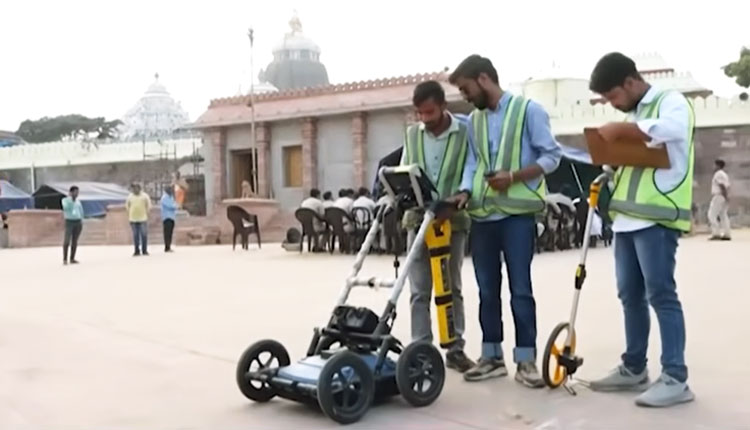
Puri: A Ground Penetrating Radar (GPR) survey conducted during the execution of the Parikrama project around the Shree Jagannath Temple has revealed significant underground archaeological features, pointing to the existence of an extensive ancient settlement beneath the holy city.
The survey, undertaken following public concerns during excavation at the Emar Math, has brought to light what experts describe as “substantial subsurface structural remains” spread beyond the immediate temple periphery.
Earlier, excavation work at Emar Math had led to the discovery of relics believed to date back to the Ganga dynasty period, including two broken lion statues. The findings had triggered public demand for a detailed scientific assessment, prompting authorities to commission the GPR survey.
According to sources familiar with the report, the findings indicate the presence of an ancient, possibly urban settlement beneath large parts of Puri city. The report suggests that these buried remains are not limited to the Parikrama project zone but extend across multiple locations, containing heritage structures and artefacts.
Among the key revelations is the indication of a possible subterranean passage linking the temple to the sea, a subject long associated with local lore. The survey has also detected structural formations within a confined area of approximately 21.6 square metres.
In the designated ‘Area-H’—covering the Emar Math zone and adjoining sites such as the Nrusingha Temple and Budhi Ma Temple, along with nearby road networks connected to the temple—at least 43 potential subsurface heritage locations have been identified.
Additionally, the survey has pointed to the presence of artefacts such as clay and metal vessels, as well as objects believed to be part of daily life in earlier periods.
While the findings are yet to be formally detailed in a public domain report, they are expected to have significant implications for heritage conservation, urban planning, and future excavation strategies in Puri.
Authorities are likely to undertake further scientific studies and consultations with archaeological experts to determine the historical significance and preservation roadmap for these newly identified subsurface remains.